
Introduction
A bubble wrap making machine should not be selected by maximum speed, working width or layer count alone. The required configuration changes with the film material, bubble geometry, product structure, roll format and downstream converting process. Drawing on extensive experience in bubble film extrusion and converting systems, ZTECH develops production solutions for standard cushioning film, laminated composites and specialized coextrusion structures. This guide explains how to work backward from the bubble film you intend to sell and translate that product specification into the necessary extrusion, forming, cooling, winding and converting equipment.
Quick Answer
The right bubble wrap making machine is the one configured around the finished film, not the model with the highest speed, widest web or largest layer count. First define the application, resin, layer structure, bubble geometry, usable width, roll format and required saleable output. These requirements determine the extrusion units, forming roller, cooling capacity, winding system and optional converting equipment. Compare suppliers using the same product specification and verify stable qualified output with the intended materials before acceptance.
Start With the Finished Bubble Film
A production-line quotation becomes meaningful only after the intended bubble film has been clearly defined. Two machines described with the same width or layer count may be designed for different materials, roll formats and output requirements.
Define the Application
Begin with the product that the bubble film will protect and the conditions it will face during storage, transport and use.
Common applications include:
- E-commerce and general protective packaging
- Furniture and glass protection
- Industrial components
- Electronic products
- Insulated composite materials
- Bubble bags and mailers
- Retail and industrial cushioning rolls
The application does not automatically determine one machine configuration. Instead, it establishes the questions the finished film must answer.
A general wrapping roll may prioritize economical material use and flexible roll dimensions. Film for sensitive components may require closer control of surface condition, cleanliness or antistatic properties. Insulation products may require aluminum foil, kraft paper, EPE foam or another facing material. Bubble-mailer production also introduces printing, laminating, folding, sealing and cutting requirements.
Define the Finished Format
Specify how the bubble film will leave the factory:
- Master rolls
- Slit rolls
- Coreless rolls
- Perforated rolls
- Cut sheets
- Bubble bags
- Laminated bubble film
- Bubble-mailer material
The main extrusion line normally produces continuous bubble film or master rolls. Slitting, perforation, rewinding, sheet cutting and bag making are separate converting processes unless they are intentionally integrated into the project.
Prepare a Product Specification
Before requesting quotations, document:
- Intended application
- Resin and additive requirements
- Layer sequence
- Bubble diameter, height and pitch
- Finished usable width
- Basis weight or layer-thickness target
- Roll width, diameter, length and weight
- Core or coreless winding
- Surface and appearance requirements
- Air-retention requirement
- Downstream processing requirements
This specification should describe the product you intend to manufacture rather than repeat the published specification of an existing machine.
What Is Included in a Bubble Film Production Line?
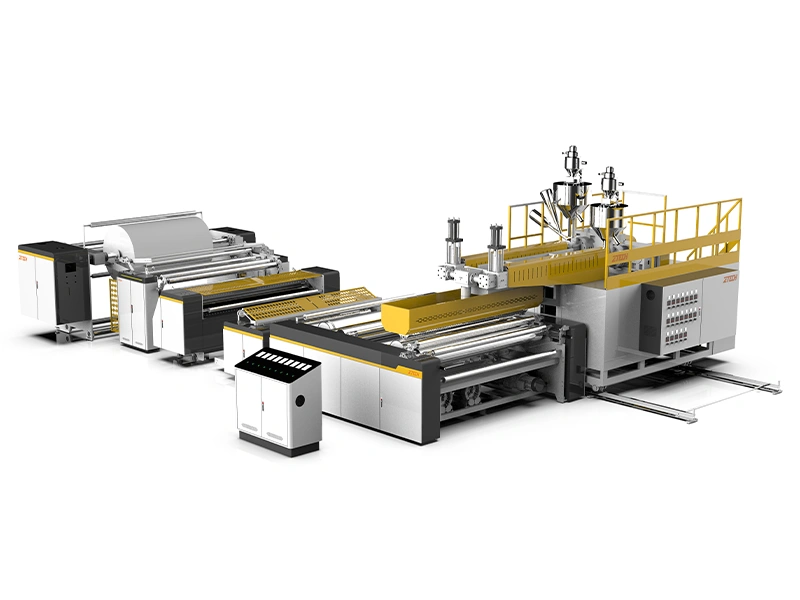
A bubble film production line converts resin into formed, laminated, cooled and wound bubble film. The exact arrangement varies, but most lines are built around the same production sequence.
Main Production Modules
A typical line includes:
- Material feeding and dosing
- Extrusion and plasticizing
- Flat-film dies
- Vacuum bubble forming
- Base-film lamination
- Cooling and traction
- Edge trimming
- Winding
- Electrical and process controls
One hot film web contacts a vacuum forming roller. The film is drawn into the roller cavities to create the bubble pattern. It is then joined to a flat base web, trapping air inside the individual bubbles. Cooling stabilizes the structure before trimming and winding.
Optional Modules
Depending on the product and automation target, a project may also include:
- Gravimetric or volumetric dosing
- Automatic material feeding
- Hydraulic screen changing
- Melt-pressure monitoring
- Edge-trim recovery
- Perforation
- Automatic cutting
- Automatic roll changing
- Additional unwinding stations
- Inline lamination
- Roll handling and labeling
Optional equipment should solve a defined production requirement. Adding automation without considering roll size, changeover frequency and downstream demand can increase cost without improving saleable output.
Main Line and Downstream Equipment
The extrusion line produces the bubble film web or master roll. Separate equipment may then perform:
- Rewinding
- Narrow-width slitting
- Roll sawing
- Fixed-length perforation
- Sheet cutting
- Bag sealing and cutting
- Mailer production
- Scrap reprocessing
Separating these functions makes quotations easier to compare and prevents downstream equipment from being mistaken for standard extrusion-line modules.
Match Materials to the Product and Machine
Material selection affects melt stability, bubble formation, bonding, mechanical performance, air retention and later converting. The machine should therefore be configured around a defined material range rather than a general statement that it is “suitable for PE.”
PE-Based Bubble Film
Most conventional bubble film uses polyethylene-based materials. However, the bubble-forming web and flat base web do not always need the same formulation.
The bubble web must form consistently over the vacuum roller and retain its geometry after cooling. The base web must seal reliably to the bubble layer and provide the required surface and handling properties.
Material planning should consider:
- Melt-processing stability
- Bubble-forming behavior
- Interlayer bonding
- Flexibility
- Puncture and tear performance
- Air retention
- Printing and sealing requirements
- Batch consistency
A material formula demonstrated at one width, basis weight or bubble size should not automatically be assumed to work under different production conditions.
Additives and Recycled Material
Color masterbatch and functional additives may be used for appearance, identification or antistatic requirements. The project should define which layer contains the additive and whether it affects forming, lamination, printing or sealing.
Recycled material may also be used in selected products, but the practical ratio depends on its source, contamination level and melt consistency. Trials should determine:
- Which layer can contain recycled material
- Whether virgin resin is needed in the surface or sealing layer
- How the material affects bubble uniformity
- Whether air retention remains acceptable
- Whether the film can still be slit, sealed or laminated reliably
The usable percentage should be established with the intended material source rather than treated as a fixed machine capability.
Functional Coextrusion Materials
Some bubble film products require more specialized material structures.
An ABA arrangement may assign different materials to the outer and inner portions of a coextruded web. Nylon may be introduced when improved gas-barrier performance and longer bubble retention are required, with compatible tie layers used between Nylon and PE.
These structures affect:
- Number of extrusion units
- Material preparation
- Feed-block design
- Processing temperatures
- Layer-ratio control
- Startup and changeover procedures
- Scrap recovery
The required material function should therefore be confirmed before the extrusion and die configuration is finalized.
Translate the Product Into a Machine Configuration
Once the product is defined, its requirements can be translated into the necessary extrusion, forming, cooling and winding modules.
Extrusion and Melt Control
Resin must be fed, melted and delivered to the die with stable temperature and pressure. Inconsistent feeding or material blending can cause output fluctuation, uneven film weight and unstable forming.
The number of extruders should be based on the independent material functions required in the finished film. Separate bubble and base webs may need different formulations, while coextruded products require additional screws or feed blocks to combine materials before the melt reaches the die.
The number of extruders should not be inferred from the advertised number of finished-product layers alone.
Bubble Forming
The forming roller establishes the nominal bubble diameter, height, pitch and arrangement. Actual bubble quality also depends on:
- Melt temperature
- Resin melt strength
- Vacuum stability
- Roller temperature
- Web contact
- Line speed
- Cooling conditions
A different bubble specification will generally require the corresponding forming roller and new processing settings.
Lamination and Sealing
The formed web is joined to a flat film while both surfaces are suitable for bonding. Material compatibility, contact temperature, web alignment and pressure affect the seal around each bubble.
Weak bonding can cause local separation or gradual air loss. Excessive pressure or unsuitable temperature can distort the bubble structure. The proposed machine should therefore be evaluated with the intended materials and product weight.
Cooling and Winding
After lamination, the film must cool sufficiently before it is exposed to traction and winding pressure. Inadequate cooling can reduce stable speed and contribute to bubble deformation, wrinkles, blocking or uneven roll hardness.
The winder must be matched to the maximum intended roll width, diameter, weight and winding format. A machine capable of producing a wide web is not automatically capable of winding every required commercial roll.
Choose the Layer Structure by Function
Layer count should be the result of product planning, not the starting point of machine selection.
| Finished-Product Requirement | Structure to Evaluate |
|---|---|
| Basic film with one bubble side and one flat backing | 2-layer |
| Bubble section enclosed between two flat films | 3-layer |
| Inline lamination with foil, paper, EPE or another web | 5-layer or laminated structure |
| Double-bubble or more complex composite | 7-layer or customized structure |
| Functional allocation of PE and PP/HDPE | ABA coextrusion |
| Longer bubble air-retention requirement | Nylon coextrusion |
A higher layer count does not automatically mean better cushioning, lower material use or higher product value. Performance depends on the material, bubble design, basis weight, layer distribution and production stability.
ZTECH’s equipment range includes conventional, laminated, ABA and Nylon configurations, but the correct choice remains the lowest-complexity structure that performs every required function.
For quotation and acceptance purposes, use a layer drawing that identifies:
- Layer order
- Material in each position
- Function of each layer
- Extruded layers
- Unwound materials
- Lamination points
This is more reliable than asking for a machine using only a term such as “five-layer bubble film line.”
Define the Critical Product Specifications
Machine selection requires more than a nominal width or a general description such as “thick bubble wrap.”
The following specifications should be defined separately:
| Product Requirement | Main Equipment Impact |
|---|---|
| Bubble diameter, height and pitch | Forming roller and processing window |
| Usable width | Die, forming roller, cooling and winder |
| Basis weight | Extruder capacity, cooling and material consumption |
| Layer distribution | Extrusion and feed-block arrangement |
| Roll diameter and weight | Winding and roll handling |
| Downstream input format | Slitting, bag making or mailer equipment |
Distinguish nominal die width from maximum working width, trimmed usable width and final slit width. Capacity calculations should use usable saleable width rather than the widest theoretical extrusion dimension.
Similarly, avoid using one total-thickness figure to describe the whole bubble structure. A measurement over the bubble peak is not equivalent to the thickness of the flat film layers. Basis weight is often more practical for production planning, while individual film measurements help confirm material distribution.
Calculate Saleable Output
Maximum line speed does not represent actual commercial production.
Different capacity terms should be distinguished:
- Mechanical speed: Maximum speed the line can reach
- Stable speed: Speed maintained without repeated adjustment
- Qualified-product speed: Speed at which the film remains within quality limits
- Shift output: Production after routine stops
- Saleable output: Qualified film after waste and rejects are deducted
A practical planning formula is:
Saleable output = usable width × stable speed × actual basis weight × uptime factor × yield factor
The final result must account for:
- Roll changes
- Material replenishment
- Cleaning and changeovers
- Edge trim
- Startup material
- Rejected film
- Damaged rolls
The bottleneck may also change between products. A standard lightweight film may be limited by winding, while a heavier multilayer product may be limited by extrusion, forming, cooling or inline lamination.
For this reason, capacity should be verified for representative products rather than one ideal running condition.
Identify the Main Production Bottlenecks
Bubble film production depends on several connected processes. A defect visible at the winder may originate earlier in feeding, extrusion, forming or cooling.
The main bottlenecks usually fall into four areas:
Extrusion Stability
Material inconsistency, contamination, changing feed rates or unstable melt pressure can cause uneven film weight and irregular forming.
Vacuum Forming
Bubble consistency depends on web temperature, vacuum distribution, forming-roller condition, web contact and line synchronization.
Cooling Capacity
The film must be stabilized before significant traction and winding pressure are applied. Cooling demand rises with width, basis weight, layer count and speed.
Winding Stability
Tension, alignment, roll hardness and unloading method must match the film structure and final roll specification.
During troubleshooting, change one variable at a time and record the original condition. Adjusting temperature, vacuum, speed and winding tension simultaneously may hide the actual cause.
Connect the Main Line With Downstream Converting
A complete bubble film project may extend beyond extrusion, but each downstream machine should be selected according to the intended finished format.
The upstream master roll and downstream machine must be compatible in terms of:
- Input width
- Roll diameter and weight
- Winding direction
- Web tension
- Surface orientation
- Sealing behavior
- Lamination or printing requirements
- Production-speed balance
For example, a slitter rewinder separates and rewinds a web, while a roll saw cuts through an already wound roll. These methods create different edges and production flows.
Bubble bag and mailer equipment also require the correct material structure, roll orientation and sealing performance.
ZTECH supplies equipment for rewinding, perforation, slitting, sheet cutting, bubble bags and mailers, allowing the production route to be planned as a connected system. However, each downstream function should still be listed separately in the quotation.
Check the Factory Requirements
The machine footprint alone is not enough to determine whether the line fits the factory.
Before installation, obtain the final configuration-specific layout and utility list. Confirm:
- Total machine dimensions
- Operating and maintenance sides
- Space for die and roller access
- Maximum roll-removal route
- Installed and estimated operating power
- Voltage, frequency and phase
- Cooling-water temperature and flow
- Chiller requirement
- Compressed-air requirement
- Material and finished-roll handling
- Downstream equipment space
- Future expansion space
The layout should follow the production flow:
Raw material → Feeding → Extrusion → Forming → Lamination → Cooling → Winding → Inspection → Converting
Avoid placing raw materials, finished rolls, scrap and forklift movement in conflicting routes. Service space should also account for opening cabinets, replacing rollers and removing major components where necessary.
Detailed foundation, aisle and utility planning should be completed using the final general arrangement drawing rather than dimensions copied from another model.
Verify the Proposed Line Before Purchase
A production trial should test the actual product the buyer intends to manufacture, not only demonstrate that the motors, heaters and controls operate.
Before testing, define:
- Resin and formula
- Layer structure
- Bubble geometry
- Usable width
- Basis weight
- Finished-roll format
- Target stable speed
- Required qualified output
- Test duration
- Quality limits
The trial should record the raw materials, machine settings, running conditions, qualified output and waste.
Possible finished-film checks include:
- Correct layer structure
- Usable width
- Basis weight
- Bubble appearance
- Lamination integrity
- Surface condition
- Roll alignment
- Air retention
- Downstream suitability
Measurement methods should be agreed in advance, including the sampling position, number of samples, instruments and permitted variation.
A sample produced slowly at a narrow width should not be treated as evidence of full-width commercial capacity.
Compare Machine Proposals on the Same Basis
Supplier quotations should be compared against the same finished-product specification.
Use the following sequence:
- Finished product
- Required machine scope
- Demonstrated stable output
- Winding and downstream compatibility
- Factory and utility requirements
- Acceptance conditions
- Documentation and service
Request evidence relevant to the proposed configuration, such as:
- Comparable film samples
- Trial records
- Technical specifications
- Layout drawings
- Utility schedules
- Production videos
- Major-component lists
- Acceptance proposals
A video of another machine running a different width, material or structure should not be treated as proof of the quoted line’s performance.
Price comparisons should also consider material waste, energy, labor, changeover time, maintenance, spare parts and downstream equipment rather than only the initial machine price.
Bubble Film Production Line RFQ Summary
A complete request for quotation should include five groups of information.
Finished Product
- Application
- Material and additives
- Layer structure
- Bubble specification
- Usable width
- Basis weight
- Roll format
Production Target
- Required saleable output
- Main product mix
- Working hours
- Changeover frequency
- Acceptable waste
Machine Scope
- Extrusion units
- Forming roller
- Cooling system
- Winder
- Inline lamination
- Automation
- Downstream equipment
Factory Conditions
- Available space
- Voltage and frequency
- Cooling-water conditions
- Compressed air
- Roll-handling method
Acceptance and Service
- Trial material
- Stable running target
- Quality limits
- Measurement methods
- Documentation
- Training
- Installation
- Spare parts
- Warranty
Providing the same RFQ information to every supplier makes technical and commercial comparisons more reliable.
Conclusion
A bubble wrap making machine should be selected from the finished product backward. Define the application, material, layer structure, bubble geometry, usable width, roll format and required saleable output before deciding on extrusion, forming, cooling, winding or automation.
The complete project must also account for downstream converting, factory utilities, material flow and measurable acceptance conditions. By comparing suppliers against the same product specification and verifying the proposed configuration with the intended materials, buyers can select a production line designed around repeatable commercial output rather than an isolated list of maximum machine specifications.
FAQs
Does changing the bubble size require a different forming roller?
Normally, yes. Bubble diameter, height, pitch and arrangement are mainly determined by the forming-roller cavity pattern. New temperature, vacuum, speed and film-weight settings may also be required.
Can one machine produce several layer structures?
Some machines can support multiple production modes, but this depends on the number of extruders, web routes, unwinding stations and lamination modules. Every required structure should be listed and confirmed in the quotation.
Should the buyer provide resin for the factory test?
Using the intended production resin is preferable when material behavior affects forming, bonding or output. The resin grade, additives and quantity should be agreed before the test.
Can the extrusion line produce finished retail rolls?
The main line usually produces master rolls. Small coreless, perforated or retail rolls may require an automatic winder or separate rewinding equipment.
What production information should be recorded after installation?
Record the material batch, layer allocation, bubble roller, usable width, basis weight, speed, temperatures, vacuum, cooling conditions, roll format, downtime, trim waste, rejected material and saleable output.