
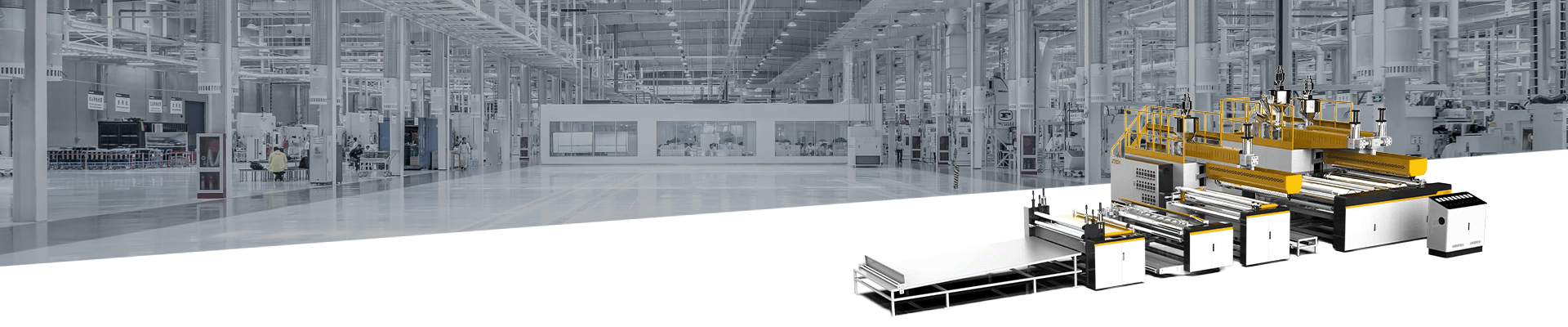
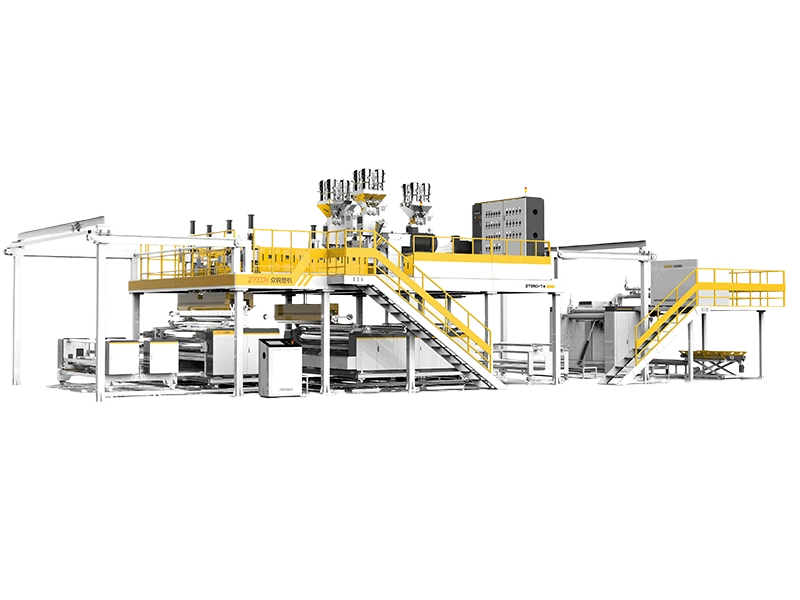
Choosing a bubble wrap machine is not simply a matter of comparing maximum speed or selecting the machine with the highest number of layers.
The right machine must match your product specifications, monthly production volume, raw materials, factory conditions, labor model and future product plans. A line that looks affordable at the quotation stage may become expensive if it produces excessive waste, requires too much manual labor or cannot run the film structure your customers need.
For U.S. packaging manufacturers, this decision has become increasingly important. The U.S. Census Bureau estimated total U.S. retail e-commerce sales at $1.2337 trillion in 2025, representing 16.4% of total retail sales. More shipped products create more demand for protective packaging, but they also increase pressure on production speed, material efficiency and delivery reliability.
This guide explains how to choose a commercial bubble wrap machine based on real production requirements rather than catalog claims.
Quick Answer: What Should You Consider Before Buying a Bubble Wrap Machine?
Before requesting a quote, define your application, film width, bubble diameter, film thickness, layer structure, monthly demand and raw materials. Then compare net output, forming quality, winding performance, automation, factory utilities, total cost of ownership and after-sales support. Maximum speed alone is not a reliable basis for choosing a machine.
First, Identify Which Type of Bubble Wrap Machine You Need
In the U.S. market, the term “bubble wrap machine” can describe several different types of equipment. Identifying the correct category prevents a costly purchasing mistake.
| Equipment type | Main input | Main output | Typical buyer |
|---|---|---|---|
| Bubble film extrusion line | PE resin pellets | Air bubble film rolls | Film manufacturers |
| Bubble wrap inflator | Pre-made film rolls | Inflated cushioning | Warehouses and 3PLs |
| Rewinder or slitter | Jumbo film rolls | Retail rolls or narrow rolls | Film converters |
| Bubble bag machine | Bubble film rolls | Bubble bags or mailers | Packaging manufacturers |
| Wrapping machine | Finished bubble film | Wrapped products | Furniture and industrial companies |
Bubble Film Extrusion Lines
A bubble film extrusion line converts plastic resin into continuous air bubble film. The process normally includes material feeding, extrusion, bubble forming, cooling, traction and winding.
This is the equipment you need if you plan to manufacture bubble film for sale or use it as an input for bubble bags, padded envelopes, insulation products or protective packaging.
On-Demand Bubble Wrap Inflators
An inflator uses a pre-made film roll and fills it with air at a packing station. It can be useful for warehouses and e-commerce fulfillment centers, but it does not manufacture the plastic film itself.
Rewinders, Slitters and Converting Equipment
If you already purchase jumbo bubble film rolls, you may only need a rewinder, slitter, perforator or bag-making machine. Buying a complete extrusion line would be unnecessary unless you also want to produce the base film.
1. Start With the Product You Want to Make
The best bubble wrap machine is determined by the film you need to sell or consume.
Match the Machine to the Application
| Application | Main film requirements | Useful machine functions |
|---|---|---|
| E-commerce packaging | Lightweight, consistent small bubbles, easy cutting | Perforation, rewinding and automatic roll handling |
| Furniture and appliances | Larger bubbles, greater impact protection, wider rolls | Wide web, stronger film and large forming rollers |
| Electronics | Stable thickness and anti-static performance | Anti-static dosing and controlled material layers |
| Glass and fragile goods | Reliable cushioning and puncture resistance | Multi-layer structure and quality monitoring |
| Insulation products | Bubble film laminated with foil, paper or foam | In-line lamination and tension control |
| Bubble bags and mailers | Flexible, sealable and printable film | Bag-making, envelope-making and printing options |
Prepare a Film Specification Sheet
Before contacting bubble wrap manufacturers, prepare the following information:
- Finished film width
- Bubble diameter
- Bubble height
- Finished film thickness
- GSM or basis weight
- Roll length
- Maximum roll diameter
- Core size
- Perforation spacing
- Required layer structure
- Color and transparency
- Raw material
- Anti-static or UV requirements
- Lamination material
- Monthly production demand
This specification sheet allows suppliers to recommend a machine configuration instead of sending a generic product catalog.
Consider the Packaging Risk
A larger bubble is not automatically better. The correct bubble size depends on the product’s weight, fragility, surface area, shipping distance, package design and expected impact.
For example, a small electronic component may require fine bubbles and anti-static protection, while a furniture manufacturer may prioritize wider film, larger bubbles and higher puncture resistance.
2. Choose the Correct Layer Structure
Layer count affects strength, air retention, material flexibility, investment cost and process complexity. More layers should only be selected when they support a clear product or commercial requirement.
2-Layer Bubble Film Machines
Two-layer machines are commonly used for standard cushioning film. They are suitable for:
- General shipping protection
- E-commerce packaging
- Furniture wrapping
- Basic logistics applications
- Cost-sensitive markets
Their main advantages are simpler operation, lower investment and easier maintenance.
3-Layer Bubble Film Machines
A three-layer structure normally adds a PE layer to the bubble layer. It can provide a better balance between strength, appearance and production flexibility.
This structure may be suitable when you need:
- Better film strength
- Different materials in separate layers
- More stable film thickness
- A wider range of customer applications
5-Layer and 7-Layer Machines
Five-layer and seven-layer machines are more suitable for specialized or higher-performance products, including:
- Laminated bubble film
- Anti-static packaging
- High-strength protective film
- Thermal insulation products
- Industrial packaging
- Multi-material structures
ZTECH’s product range includes 2-layer, 3-layer, 5-layer and 7-layer air bubble film machines, as well as advanced co-extrusion configurations. Selected models are available with finished film widths of 1,500, 2,000 or 2,500 mm. The final structure should always be confirmed with a cross-section diagram because layer-count terminology can vary between manufacturers.
| Layer structure | Suitable for | Advantages | Trade-offs |
|---|---|---|---|
| 2-layer | Standard packaging | Lower cost, simpler operation | Fewer functional options |
| 3-layer | Stronger cushioning | Better strength-to-cost balance | Higher investment |
| 5-layer | Functional or laminated film | More flexibility and performance | More complex process |
| 7-layer+ | Specialized industrial products | Advanced barrier and performance | High cost and maintenance |
Do not buy a seven-layer machine simply because it sounds more advanced. If your customers only require standard cushioning film, the additional extruders, energy consumption and maintenance may not improve your return on investment.
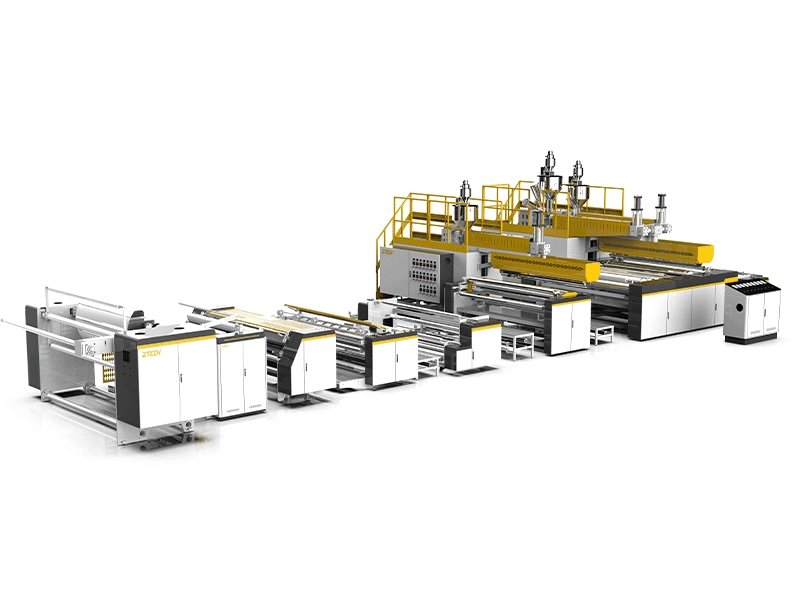
Five-Layer Air Bubble Film Lamination Machine for High-Performance Packaging
3. Calculate the Capacity You Actually Need
One of the most common mistakes when buying a bubble wrap making machine is choosing by maximum speed alone.
A supplier may advertise a line speed of 100 meters per minute, but your actual saleable output will also depend on film width, GSM, bubble size, material formulation, start-up waste, changeover time, maintenance and operator skill.
Rated Output vs. Net Output
Ask the supplier to distinguish between:
- Maximum line speed
- Rated output
- Net output
- Saleable output
- Start-up waste
- Changeover losses
- Planned maintenance
- Scrap rate
You should request a sustained production result under your target conditions, not an empty-machine speed.
Basic Output Formula
For a preliminary estimate:
Net output =
finished width × line speed × 60 × finished GSM × yield
Use consistent units. For U.S. buyers, the final result should be converted to pounds per hour.
A second formula helps you work backward from monthly demand:
Required rated output =
monthly demand ÷ productive hours per month ÷ planned utilization
Useful conversions include:
- 1 kg = 2.205 lb
- 1 inch = 25.4 mm
- 1 mil = 25.4 microns
- 1 meter = 3.281 feet
Example Calculation
Assume your business needs:
- 100,000 square meters of film per month
- Finished GSM of 55 g/m²
- 176 productive hours per month
- Planned utilization of 75%
Material demand:
100,000 × 0.055 = 5,500 kg per month
Converted to U.S. units:
5,500 kg × 2.205 = approximately 12,125 lb per month
Required net output:
12,125 ÷ 176 = approximately 68.9 lb/hr
Required rated output:
68.9 ÷ 0.75 = approximately 91.9 lb/hr
In this example, a machine capable of approximately 90–110 lb/hr under the specified film conditions may be a reasonable starting point for evaluation.
This is only a planning example. The supplier should validate the result using your actual film width, bubble size, thickness, GSM and resin formulation.
What to Ask the Supplier
- Is the stated output gross or net?
- What film width was used?
- What GSM was used?
- Was the test conducted with virgin or recycled material?
- How much start-up waste was produced?
- How long can the line run continuously?
- What is the output after normal temperature stabilization?
- Does the output include edge trim?
- What happens when the bubble roller is changed?
- Can the result be demonstrated with our material?
4. Match Bubble Size, Film Thickness and Quality Requirements
Bubble size and film thickness are related, but they are not interchangeable.
Bubble Diameter and Bubble Height
Bubble diameter describes the width of the bubble pattern. Bubble height describes how far the bubble projects from the film surface.
Two films may have a similar diameter but different heights, cushioning behavior and material consumption.
ZTECH forming roller options can be configured for different bubble patterns, including examples such as:
- 6 × 2.5 mm
- 10 × 4 mm
- 25 × 10 mm
- 30 × 12 mm
The actual available configuration depends on the selected forming roller, machine model and final product specification.
Film Thickness and GSM
U.S. buyers commonly discuss film thickness in mil, while many equipment catalogs use microns or GSM.
Useful conversions include:
- 1 mil = 25.4 microns
- 1 inch = 25.4 mm
- 1 kilogram = 2.205 pounds
Always confirm whether the stated GSM refers to:
- One PE layer
- The finished bubble film
- The complete laminated structure
- The material including coating or foil
Components That Affect Film Quality
The key components include:
- Extruder and screw: melting and material stability
- Die head: melt distribution and film thickness
- Forming roller: bubble shape and size
- Cooling system: bubble stability
- Tension control: film flatness and roll quality
- Winder: roll diameter, length and consistency
- Pressure and temperature sensors: process visibility
Recommended Quality Checks
Before accepting a machine, evaluate:
- Film thickness across the web
- Finished GSM
- Bubble diameter consistency
- Bubble height consistency
- Bubble breakage rate
- Puncture resistance
- Lamination peel strength
- Roll length accuracy
- Roll tension
- Start-up waste
- Continuous running stability
For the finished packaging system, use an appropriate transport or impact test. ASTM packaging guidance covers cushioning materials, transport packaging and distribution conditions; the correct test should be selected according to the product and shipping environment.
5. Confirm Raw Material Compatibility
A machine should be selected around the material formula, not the other way around.
LDPE and LLDPE
LDPE is commonly selected for flexibility and processing performance. LLDPE can be used to improve strength and puncture resistance.
The correct blend depends on:
- Required film strength
- Bubble stability
- Target GSM
- Processing temperature
- Customer requirements
- Cost target
Nylon Co-Extrusion
For specialty applications, nylon co-extrusion can provide higher toughness and improved air-retention potential. It should be tested against the actual product requirements rather than selected only for marketing value.
Recycled Material
Many manufacturers want to use recycled resin to reduce material costs and improve sustainability. However, recycled material can vary in:
- Moisture
- Contamination
- Melt flow index
- Color
- Odor
- Thermal history
- Particle size
Ask whether the machine includes:
- Material mixing
- Drying
- Automatic dosing
- Hydraulic screen changing
- Melt filtration
- Edge-trim recycling
Recycled-material compatibility should be confirmed through a production trial. A machine that can technically accept recycled resin may still produce unstable bubbles or unacceptable appearance if the feedstock is inconsistent.
6. Decide Which Functions You Actually Need
Automation should be evaluated by its effect on labor, waste, quality and uptime.
Useful Automation Features
Depending on production volume, consider:
- PLC and touchscreen HMI
- Automatic tension control
- Automatic edge alignment
- Pressure sensors
- Temperature monitoring
- Automatic roll changing
- Automatic splicing
- Automatic roll unloading
- Production data tracking
- Remote troubleshooting
Optional Downstream Equipment
A complete bubble film solution may include:
- Heating lamination unit
- Perforator
- Slitter
- Rewinder
- Coreless rewinder
- Bubble bag-making machine
- Bubble mailer or envelope machine
- In-line printer
- Anti-static unit
- Material mixer and dryer
- Chiller
- Edge-trim recycling system
ZTECH supplies equipment across the bubble film, rewinding, slitting, bag-making and recycling stages. This can be useful when you want one production plan rather than several disconnected machines.
Plan for Future Products
Before ordering, ask:
- Will you produce larger bubble sizes?
- Will you add laminated film?
- Will you sell bubble bags?
- Will you need wider rolls?
- Will you increase recycled content?
- Will you need retail-size rolls?
- Will customers request anti-static or specialty film?
A modular machine may provide better long-term value than the cheapest machine designed for only one product.
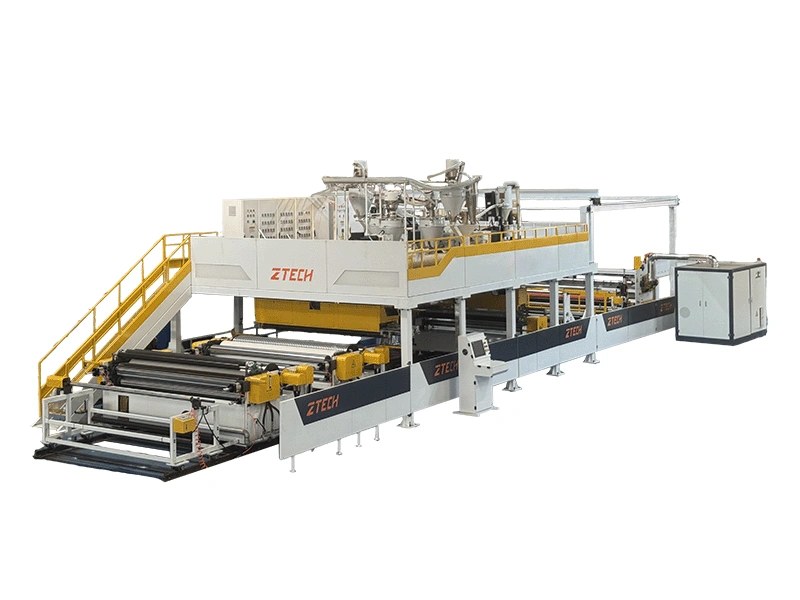
Nylon Co-Extrusion Air Bubble Film Machine for High-Strength Packaging
7. Check Your U.S. Factory Before Ordering
A machine that fits the product specification may still fail if it does not fit the factory.
Factory Checklist
Confirm:
- Overall line length
- Maximum line height
- Ceiling clearance
- Door and loading access
- Floor loading
- Forklift or crane access
- Maintenance space
- Resin storage area
- Finished-roll storage
- Cooling water or chiller
- Compressed air
- Ventilation
- Heat removal
- Electrical connection
- Fire and workplace safety requirements
Electrical Requirements
Do not assume that a standard machine configuration will match your plant. Ask the supplier to confirm:
- Voltage
- Phase
- Frequency
- Main disconnect
- Control cabinet requirements
- Motor and inverter specifications
- Emergency-stop configuration
The final electrical installation should be reviewed for the specific U.S. facility by a qualified local professional.
Machine Guarding and Maintenance Safety
The machine should provide appropriate guarding around rollers, drives, cutting areas and other moving components. OSHA identifies machine guarding and point-of-operation protection as essential parts of workplace safety. Maintenance procedures should also address hazardous energy and lockout/tagout requirements under 29 CFR 1910.147.
8. Compare Total Cost of Ownership
The purchase price is only one part of the investment.
Cost Categories to Compare
| Cost category | What to check |
|---|---|
| Main machine | Extruders, die head, forming roller and winder |
| Auxiliary equipment | Chiller, mixer, dryer, compressor and recycler |
| Shipping | Freight, insurance, customs and inland delivery |
| Installation | Assembly, commissioning and site supervision |
| Training | Number of operators, training days and manuals |
| Electricity | Connected power and actual consumption |
| Labor | Required operators per shift |
| Material waste | Start-up, edge trim and changeover loss |
| Maintenance | Heaters, sensors, blades, filters and belts |
| Downtime | Spare-parts availability and support response |
| Expansion | Future modules and upgrade costs |
Simple ROI Formula
For internal consumption:
Monthly net benefit =
avoided cost of purchased bubble film
− in-house labor
− electricity
− maintenance
− waste
− financing cost
For a film manufacturer:
Monthly net benefit =
saleable film revenue
− resin cost
− labor
− energy
− maintenance
− waste
− distribution cost
Payback period =
total installed investment ÷ monthly net benefit
Do not accept an ROI calculation unless the assumptions are visible. A payback estimate should specify the selling price, resin price, labor cost, operating hours, utilization and scrap rate.
9. New vs. Used Bubble Wrap Machines
Used equipment may reduce the initial investment, but it requires more technical due diligence.
A New Machine Is Usually Better When:
- You need a customized width or layer structure.
- You plan to use recycled or specialty materials.
- You require a full warranty.
- You need installation and operator training.
- You expect to expand production.
- You need a new control system and reliable spare parts.
A Used Machine May Be Practical When:
- Your film specifications are stable.
- You have experienced maintenance staff.
- The machine has complete records.
- Replacement parts remain available.
- The total relocation cost is acceptable.
Used Machine Inspection Checklist
Inspect:
- Year of manufacture
- Operating hours
- Extruder screw and barrel wear
- Die-head condition
- Forming roller surface
- Winder and tension system
- PLC and inverter availability
- Electrical compatibility
- Maintenance records
- Previous production material
- Spare-parts availability
- Installation and commissioning responsibility
A low purchase price is not attractive if the machine cannot produce your required film or remains idle while waiting for obsolete parts.
10. How to Evaluate Bubble Wrap Manufacturers
A reliable bubble wrap manufacturer should be able to discuss your product, not just send a price list.
Ask for Evidence of Technical Capability
Request:
- Factory photographs or video
- Machine layout drawings
- Product cross-section diagrams
- Technical data sheets
- Production videos
- Customer references
- Test-film samples
- Maintenance manuals
- Spare-parts lists
- Warranty terms
- Installation plan
Use FAT and SAT
A Factory Acceptance Test should be performed before shipment when possible. It should use:
- Your target resin
- Your target film width
- Your target bubble size
- Your target GSM
- Your target thickness
- Your target production speed
After installation, the Site Acceptance Test should confirm the machine under actual plant conditions.
Clarify Certification Language
Ask exactly which machine, model and standard each certificate covers. A CE or machinery-directive document may support equipment conformity, but it should not automatically be presented as U.S. UL or ETL approval.
For a U.S. installation, confirm the electrical and workplace-safety requirements that apply to your facility and state.
Include Service Terms in Writing
The contract should specify:
- Installation scope
- Training scope
- Warranty period
- Remote-support response time
- On-site service availability
- Spare-parts lead time
- PLC backup policy
- Software support
- Acceptance criteria
- Responsibility for travel and labor costs
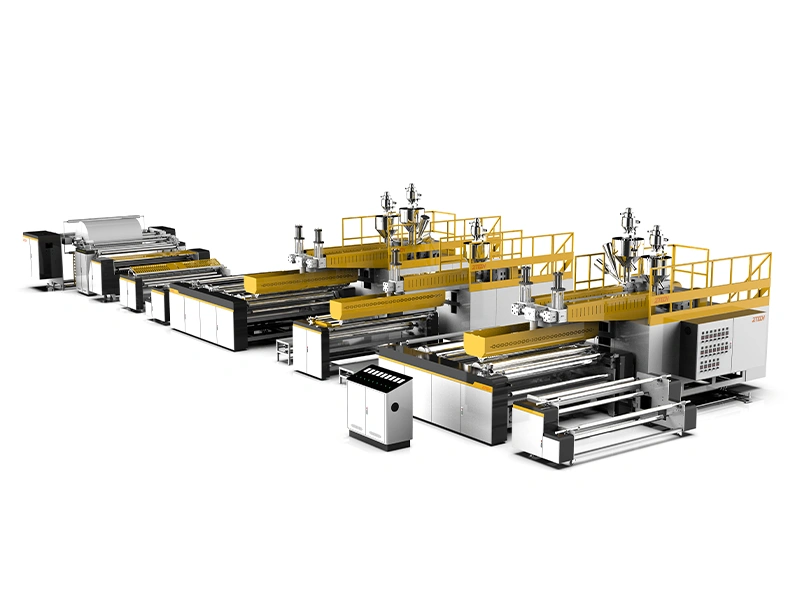
Seven-Layer Air Bubble Film Lamination Machine for Specialty Packaging
11. Which Machine Configuration Fits Your Business?
Small Packaging Material Supplier
Consider:
- 2-layer or basic 3-layer equipment
- Medium finished width
- Simple but stable winding
- Easy access to wear parts
- Upgradeable control system
- Lower initial investment
High-Volume Commercial Manufacturer
Consider:
- High net output
- Automatic roll change
- Multi-layer co-extrusion
- Online edge recycling
- Automatic tension control
- Multiple forming rollers
- Strong spare-parts planning
Electronics Packaging Supplier
Consider:
- Anti-static dosing
- Fine bubble sizes
- Stable film thickness
- Controlled raw-material formulation
- Quality inspection records
- Clean and consistent winding
Insulation and Laminated Film Producer
Consider:
- Aluminum foil or kraft-paper lamination
- PE foam lamination
- Multiple unwinders
- Tension control
- Wide-web capability
- Slitting and rewinding equipment
12. Common Mistakes to Avoid
- Choosing the highest advertised speed.
- Confusing an inflator with a film extrusion line.
- Assuming more layers always mean better performance.
- Accepting recycled-material claims without a trial.
- Ignoring forming roller changeover time.
- Forgetting roll diameter and core requirements.
- Comparing machine-only prices.
- Failing to check factory height and floor loading.
- Buying used equipment without maintenance records.
- Leaving FAT and SAT requirements out of the contract.
- Treating CE documentation as automatic U.S. certification.
- Using unverified customer cases or unsupported energy-saving claims.
Expert Tips for Choosing the Right Machine
- Start with the film specification, not the machine catalog.
- Calculate required lb/hr before comparing models.
- Ask for a cross-section diagram for every layer configuration.
- Test the machine with your actual resin.
- Compare sustained output, not peak speed.
- Request the complete plant layout before paying a deposit.
- Put spare-parts lead times in writing.
- Use a real customer reference call when possible.
- Treat every supplier performance claim as a testable assumption.
Conclusion
Choosing the right bubble wrap machine starts with your finished film, not the machine catalog.
Define your application, calculate your required output, select the appropriate layer structure, confirm material compatibility and check your factory conditions before comparing prices. Then evaluate the supplier’s testing process, documentation, spare-parts plan and after-sales support.
ZTECH provides 2-layer, 3-layer, 5-layer, 7-layer and advanced co-extrusion air bubble film solutions, together with forming rollers, lamination, rewinding, slitting, bag-making and recycling equipment.
To receive a suitable configuration, send us your target film width, bubble size, thickness, GSM, monthly output, raw material and factory location. Our technical team can recommend a machine configuration based on your actual production requirements.
Request a Commercial Bubble Wrap Machine Quote
Frequently Asked Questions
What is the difference between a bubble wrap machine and a bubble film machine?
They usually refer to the same type of production equipment. “Bubble film machine” is the more technical term, while “bubble wrap machine” is more common among commercial buyers and packaging companies.
Can a bubble film machine use recycled plastic?
Many machines can process a percentage of recycled resin, but the result depends on moisture, contamination, melt flow and filtration. Always conduct a trial using the actual recycled material.
Is a 2-layer or 5-layer machine better?
A 2-layer machine is usually sufficient for standard cushioning. A 5-layer machine is more appropriate for high-strength, laminated or functional film. The better choice depends on your product portfolio.
What bubble size should I choose?
Small bubbles are often suitable for small parcels, electronics and light products. Larger bubbles are commonly selected for furniture, appliances and products requiring greater cushioning volume.
How much output do I need?
Calculate monthly film demand in pounds, divide it by productive hours, and adjust for utilization, changeovers, maintenance and waste. Do not use maximum line speed as your expected saleable output.
What is the difference between a bubble wrap machine and an inflator?
A bubble wrap production machine converts resin into film. An inflator uses pre-made film rolls and fills them with air at a packaging station.
How much factory space does a commercial bubble wrap machine need?
The requirement depends on finished width, number of extruders, cooling system, forming rollers, winder and maintenance access. Request a complete general arrangement drawing before ordering.
What should I ask bubble wrap manufacturers?
Ask about net output, test conditions, materials, bubble sizes, thickness range, forming roller options, energy use, factory utilities, spare parts, installation, training, warranty and acceptance testing.
Should I buy a new or used bubble wrap machine?
New equipment is usually better for customized products, specialty materials and long-term expansion. Used equipment can be practical for stable products when its condition, control system and spare-parts support have been verified.
How do I compare bubble wrap machines for sale?
Compare the total installed cost, including shipping, auxiliary equipment, installation, training, energy, labor, waste, maintenance and downtime. A lower machine price does not necessarily mean a lower production cost.