

Introduction
Before approving a bubble film machine for shipment, the buyer needs evidence that the completed line can produce saleable film under the materials and specifications agreed in the contract. A machine that starts, runs empty or briefly reaches a high speed has not necessarily passed acceptance. Drawing on its experience with multilayer and coextrusion bubble film lines, ZTECH treats FAT as a combined check of configuration, stable production, film quality, winding, controls and delivery scope. The purpose is not to approve a short demonstration, but to collect measurable evidence before shipment and the next payment or project milestone.
Quick Answer
Accept a bubble film machine only after it produces conforming, usable rolls under the raw materials and product specification stated in the purchase contract or approved test protocol. The FAT should verify the delivered configuration, stable running period, saleable output, film width, thickness or GSM, layer structure, bubble formation, air retention, winding quality, alarms, guards, emergency stops, documents, spare parts and training. Record actual results, waste, samples, photos, videos and open issues. A temporary speed reading or short successful run is not enough to release the machine for shipment.
Prepare the FAT Before the Machine Starts
Use the Contract as the Baseline
Use the purchase contract, technical agreement, approved layout, configuration list and confirmed product specification as the acceptance baseline. Every test item should connect to an agreed requirement. Where no universal value applies, compare the result with “the contracted value,” “the agreed specification” or “the approved test protocol” rather than creating a tolerance during the test.
Define Responsibilities and Records
Confirm who supplies materials, operates the machine, performs measurements, records evidence and has signing authority. Also separate items that must pass before shipment from those that depend on site installation.
Prepare a numbered record containing the test item, contract requirement, test condition, actual result, pass/fail status, evidence, corrective action and retest result. Samples, photographs and videos should carry the same test ID.
Confirm the Ordered Machine Configuration
Compare the delivered line with the approved order. Check the extrusion unit, die, forming section, cooling, haul-off, trimming or slitting, winding, controls and auxiliary equipment.
ZTECH's air bubble film machine range includes two- and three-layer models, five- and seven-layer lamination systems, and ABA or nylon coextrusion configurations. During FAT, buyers should verify that the delivered machine matches the purchased model in layer structure, material flow and independently controlled functions.
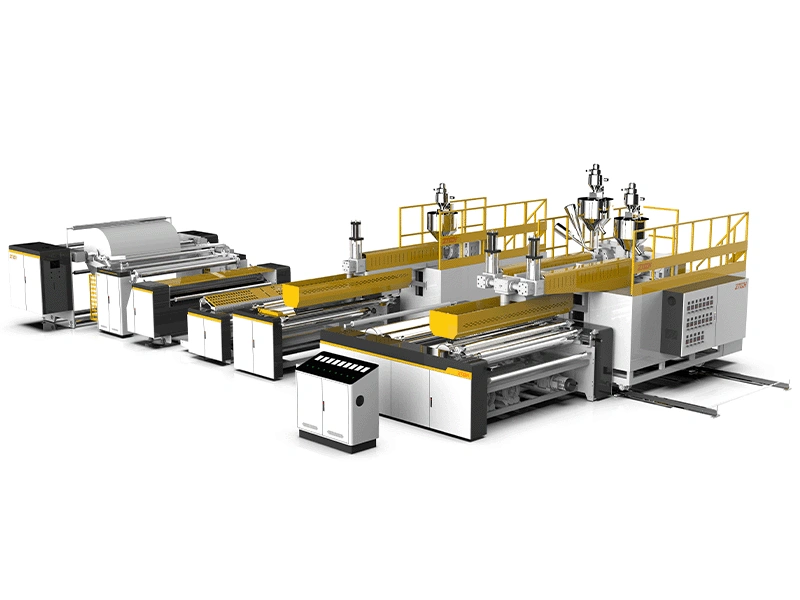
Demonstrate every ordered option rather than checking its appearance. Depending on the contract, this may include a screen changer, tension control, automatic or coreless winding, edge trimming, perforation, cutting, recycling, material mixing or drying, cooling, compressed air or in-line printing.
Fix the Test Materials and Product Specification
Record the resin type and grade, virgin or recycled content, blend ratio, color masterbatch, additives and batch where relevant. A trial using an easy-running resin may not represent the buyer’s product.
Define the number of layers, film width, thickness or GSM, material in each layer, bubble roller and bubble size, laminated substrate, core, roll diameter and roll length or weight.
During the trial, retain temperature settings, line speed, cooling conditions, haul-off status, winding tension and parameter changes. The aim is to make the result traceable and reproducible, not to establish one universal recipe.
Run a Stable Production Trial
Separate Startup From Stable Production
Divide the trial into startup, adjustment and stable production. Film made while temperatures, width, forming or winding are still being corrected should not count as stable output. Start the acceptance window only when the product meets the agreed specification.
Observe Stability and Recovery
Record repeated parameter changes, film breaks, temperature fluctuations, width drift, interrupted bubble formation, winding deviation and manual intervention. One acceptable sample immediately after adjustment does not prove sustained performance.
Where included in the protocol, test recovery after a normal stop, film break, material interruption or cleared alarm. Use the documented procedure and confirm that production can resume without unsafe actions, lost settings or excessive waste.
Verify Saleable Output, Not Just Machine Speed
Maximum line speed and saleable output are different measures. Record gross production, then separate startup scrap, adjustment waste, edge trim, film rejected for width or thickness, bubble defects, winding defects and conforming finished rolls.
The key result is how much acceptable film the line produces during the stable test period. Compare line speed, test duration, gross output, waste and saleable output with the contract together. This prevents a short high-speed demonstration from hiding low yield or unstable quality.
Check Film Width, Thickness and Layer Structure
Measure usable width after required trimming and check whether it changes during the run. A single sample from the center is not enough, so use a practical matrix:
Left / Center / Right × Beginning / Middle / End
This is not a universal standard, but it reveals cross-web and time-based variation.
Measure thickness, GSM or both according to the order. For multilayer products, verify material or color arrangement, layer bonding and any independently controlled layer function included in the specification. Do not rely only on the visible number of extruders.
Inspect Bubble Formation and Air Retention
Inspect bubble shape, size and distribution. Record continuous missing bubbles, weak forming, broken or collapsed areas, and defects concentrated on one side or repeating at a fixed interval.
Air-retention testing should follow the method approved before FAT, including sample location, quantity, storage conditions, inspection time and pass criteria. This is especially relevant when the ordered line is intended for extended air retention, such as a nylon coextrusion configuration.
The FAT confirms that the machine can repeatedly produce the agreed film. Separate compression, cushioning or transport-performance qualification may still be required for the final packaging product.
Evaluate Winding and Finished-Roll Quality
Inspect rolls for wrinkles, wandering, uneven edges, telescoping, inconsistent tightness, core slip and local bubble crushing. Compare the result with the ordered core, width, diameter, length or weight.
Test only the winding functions included in the order, such as automatic cutting, roll change, double-shaft winding, coreless winding, tension control, slitting or perforation. Record downtime, waste and the quality of the new roll’s starting section during changeover.
Test Controls, Alarms and Safety Functions
Check normal start, stop, speed adjustment, parameter display, access levels and saved settings. Test specified temperature, drive, web-running and guard-related alarms under controlled conditions.
Authorized personnel should verify emergency stops, guards, safety doors, interlocks and restart procedures. The machine must return to a safe state and must not restart unexpectedly. After an alarm, confirm that settings remain available and production can recover through the documented procedure. Never bypass a safety device to complete FAT.
Review Utilities and Separate FAT From SAT
Record the power supply, cooling water, compressed air, ambient conditions and auxiliary equipment used during FAT, then compare them with the buyer’s planned site.
FAT can verify configuration, controlled production, film quality, winding, controls, safety, documents and spare parts. SAT may still be needed for site power, foundations, ventilation, utilities, upstream or downstream integration and performance during real production shifts.
Check Documents, Spare Parts and Training
Review manuals, electrical drawings, layout, software or parameter backups, spare-parts lists, wear-parts lists and agreed certificates. Count supplied parts and tools against the order and check their labels.
Training should cover the contracted tasks, including startup, shutdown, material changes, parameter adjustment, winding, routine inspection, cleaning, maintenance, alarms and safety. Missing documents, parts or training must remain open items.
Record Open Issues and Make the Release Decision
Each nonconformity should identify the test ID, contract requirement, measured result, evidence, impact, responsible party and due date. Corrective action may involve adjustment, repair, replacement, document revision, training or another production trial.
Retest failed items with the same material, product specification, method and acceptance criterion unless a written change is approved.
Use one of three clear outcomes:
- Accepted: all critical items pass.
- Conditionally accepted: limited non-critical items have an agreed closure plan.
- Held for retest: a critical production, quality or safety requirement fails.
Shipment and payment release should follow the contract.
Bubble Film Machine FAT Record Template
| Test ID | Acceptance Item | Contract Requirement | Test Conditions | Actual Result | Pass / Fail | Evidence | Corrective Action | Retest Result |
|---|---|---|---|---|---|---|---|---|
| Machine configuration | ||||||||
| Materials and product | ||||||||
| Stable production | ||||||||
| Saleable output | ||||||||
| Width, thickness and layers | ||||||||
| Bubble quality and retention | ||||||||
| Winding quality | ||||||||
| Controls and safety | ||||||||
| Documents, parts and training |
Conclusion
A factory acceptance test should prove more than the ability to run an air bubble film making machine. It should demonstrate that the exact ordered configuration can use agreed materials to produce stable, measurable and saleable finished rolls.
For a ZTECH bubble film line, the release decision should be supported by representative materials, defined conditions, cross-web and time-based sampling, separated waste and accepted output, roll inspection, safety checks and traceable issue closure. These records show whether the equipment is ready to ship and which site-dependent items still require SAT verification.
FAQ
Can a Remote FAT Be Reliable?
Yes, when the plan is fixed in advance and the buyer controls the evidence. Use continuous video for critical runs, close-up views of instruments and samples, visible timestamps and test IDs, and copies of raw records rather than only an edited summary. Independent inspection can add confidence when the buyer cannot attend.
How Many Product Recipes Should Be Tested?
Test the contracted products that represent the machine’s critical operating range, not every possible recipe. A second recipe is useful when it changes a major risk, such as layer structure, recycled content, laminated material, bubble roller or winding method. Agree on the recipes before FAT.
Should FAT Film Samples Be Retained?
Yes. Label samples with the machine, date, test ID, recipe, web position and production time. Retained samples provide a direct comparison with film produced after installation and can help resolve quality differences during SAT or early production.
Which Results Should Be Repeated During SAT?
Repeat results that may change because of site utilities, foundations, ventilation, material handling, connected equipment or local operators. Reproducing one approved FAT product at the buyer’s factory helps separate installation effects from machine or recipe issues.
Can the Machine Ship With Open FAT Items?
Only when the contract permits conditional acceptance and the remaining items do not affect safety or core performance. Each item needs an owner, deadline, evidence requirement and verification method. Critical output, product-quality or safety failures should hold the machine for retest.