
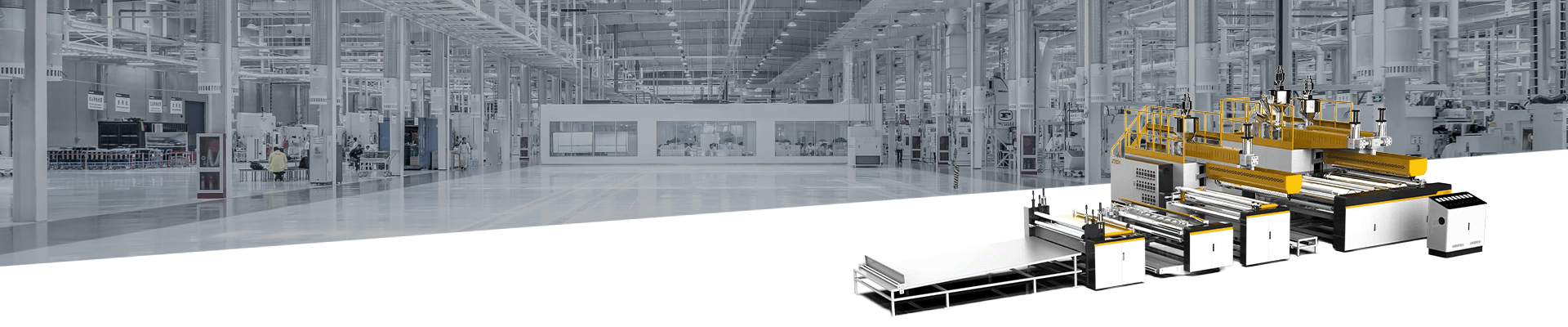
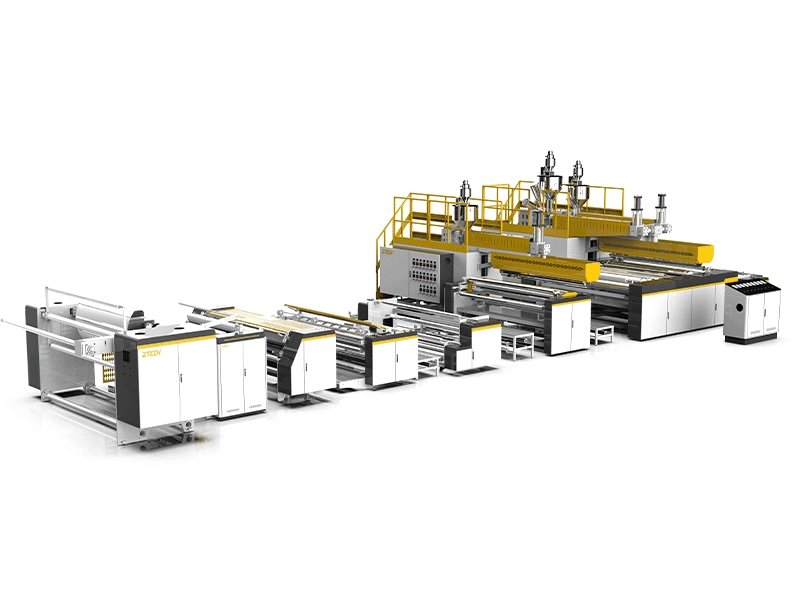
When choosing a bubble film machine, line speed is usually the first number buyers compare. A machine rated at 1,100 m/h may sound better than one rated at 800 m/h. However, speed alone does not tell you how much sellable film the line will produce.
Published industrial specifications currently show line speeds of roughly 700–2,280 m/h and outputs from about 45–250 kg/h, depending on film width, thickness, bubble size, material and machine configuration. These figures are reference ranges, not universal production guarantees.
The practical question is not “How fast can the machine run?” It is:
What is the fastest speed at which the machine can continuously produce film that meets your thickness, bubble and strength requirements?
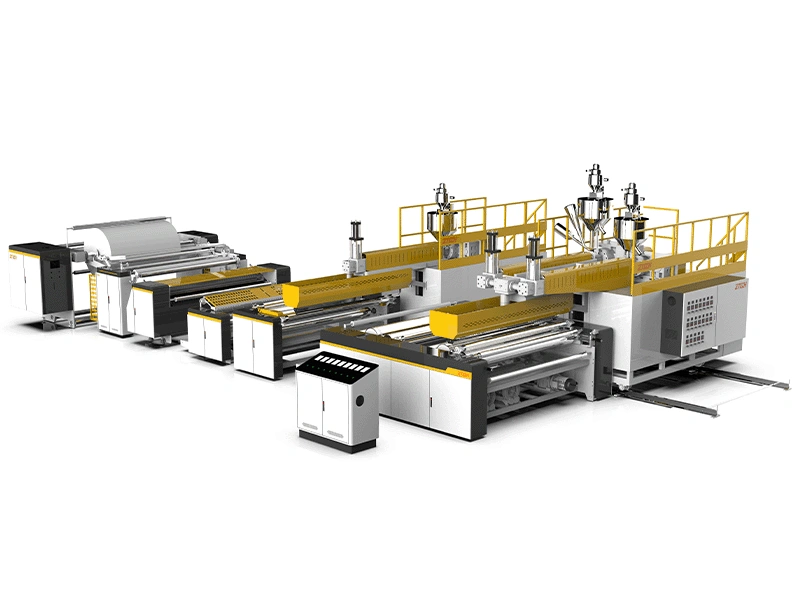
3-Layer Air Bubble Film Machinery for Stable Output and Uniform Film Quality
Speed, Output and Sellable Capacity Are Different
A bubble wrap machine has three important speed-related measurements:
- Line speed: film travel speed, usually measured in m/min or m/h.
- Screw speed: extruder rotation speed, measured in rpm.
- Output: material throughput, measured in kg/h.
These values are connected, but they are not interchangeable. If traction speed increases while extrusion output remains unchanged, the film generally becomes lighter or thinner. If extrusion output increases without enough cooling, the melt may remain too soft during bubble forming.
A useful planning formula is:
Output (kg/h) ≈ effective film width (m) × line speed (m/h) × film weight (g/m²) ÷ 1,000
For example, a 1.5 m wide film running at 1,000 m/h and weighing 80 g/m² has a theoretical output of approximately 120 kg/h. Actual sellable output will be lower after trimming, start-up waste, roll changes, cleaning and quality rejects.
Six Factors That Control Bubble Film Machine Output
1. Extruder and die capacity
The extruder must deliver a stable melt flow before the line can run faster. Screw diameter, length-to-diameter ratio, motor torque, filtration and die design all affect the maximum practical output.
A larger screw may increase throughput, but it does not automatically improve quality. If temperature control or mixing is poor, higher output can create gauge variation, streaks or weak bubble walls.
2. Film width and thickness
Width and thickness directly affect the speed-output balance. A wider film requires more material per meter. A heavier film also requires more melt flow at the same line speed.
For this reason, a supplier should state output together with:
- Effective film width
- Finished film weight or thickness
- Bubble diameter and height
- Number of layers
- Resin grade and recycled content
A speed claim without these conditions is difficult to compare.
3. Resin and recycled material
LDPE and LLDPE are commonly used for bubble film, but melt flow, moisture, contamination and batch consistency can change the stable operating window.
Recycled resin can reduce material cost, but inconsistent flakes may cause pressure fluctuation, blocked filters and uneven bubble formation. The better approach is to qualify recycled content by testing thickness variation, bubble retention and tensile performance—not by assuming that a fixed percentage will work on every line.
4. Bubble size and forming stability
Large bubbles provide more cushioning volume, but they also require accurate vacuum control, forming-roller temperature and web tension. At high speed, incomplete sealing or uneven bubble height can appear before the operator notices a major change in total output.
A film roll that is longer but contains partially formed or leaking bubbles is not a productivity gain.
5. Cooling system capacity
Cooling is often the hidden speed limit. The film must be sufficiently solidified before it leaves the forming section and enters the traction and winding stages.
Air rings, water-cooled forming rollers, cooling rollers and internal cooling systems all remove heat at different stages. Uneven airflow or unstable cooling-water temperature can cause:
- Collapsed or distorted bubbles
- Wrinkles
- Sticky surfaces
- Cross-web thickness variation
- Poor winding tension
Some published lines combine water-cooled forming rollers with output ranges up to 250 kg/h, but the actual result still depends on product specifications and operating conditions.
6. Traction, tension and winding
The final speed must be coordinated across the forming roller, nip rollers, edge trimming and winder. Excessive traction can stretch the film and reduce its actual weight. Excessive winding tension can crush bubbles or create telescoped rolls.
Stable automatic tension control is often more valuable than a higher headline speed, especially for e-commerce, furniture and export packaging where roll consistency matters.
How to Find the Best Stable Production Speed
Use a controlled speed trial instead of adjusting several settings at once:
- Start with a verified resin recipe and a low-speed baseline.
- Fix the film width, weight, bubble size and layer structure.
- Increase line speed in steps of 5%–10%.
- Allow melt pressure, temperature, cooling and tension to stabilize.
- Record output, waste, thickness variation, bubble height, roll appearance and energy use.
- Select the highest speed that passes the agreed quality limits over a full production shift.
Some equipment specifications quote thickness uniformity within ±3%, but this should be verified using your own material and product design rather than accepted as a universal benchmark.
What Should Be Tested Before Acceptance?
A proper machine trial should measure more than kg/h. Ask the supplier to document:
- Net saleable output after waste
- Film width and weight
- Thickness variation across and along the web
- Bubble diameter, height and air retention
- Roll hardness and winding alignment
- Start-up waste and roll-change time
- Electricity and cooling-water consumption
- Continuous running time without instability
For packaging applications, dynamic cushioning can be evaluated using ASTM D1596, while gross package leaks can be checked with ASTM D3078. Seal strength testing can follow ASTM F88/F88M. These standards help convert “good quality” into measurable acceptance criteria.
Common Mistakes That Reduce Real Output
- Comparing machines only by maximum m/h
- Increasing traction without increasing melt output
- Changing resin and speed at the same time
- Ignoring cooling-water flow or air distribution
- Using high winding tension to hide a web-alignment problem
- Measuring gross production instead of saleable production
- Accepting a short demonstration instead of a full-shift trial
Which Configuration Fits Your Application?
| Application | Main priority |
|---|---|
| E-commerce shipping | Stable speed, low waste and fast roll changes |
| Furniture and large products | Wide film, uniform bubbles and reliable winding |
| Electronics | Air retention, clean film and traceable quality |
| Insulation or laminated film | Multi-layer control and online lamination |
| High recycled content | Filtration, melt stability and recipe flexibility |
Final Takeaway
The best bubble film machine is not necessarily the fastest machine. It is the line that delivers the required film width, weight, bubble performance and roll quality at a predictable operating cost.
Before buying, send the supplier your target width, film weight, bubble size, resin mix and daily production requirement. Then request a trial that reports net kg/h, waste rate and quality results together.
Need help selecting the right configuration? Submit your film width, thickness, bubble size and daily output target for a capacity recommendation.
FAQ
Does higher speed always increase output?
No. Output rises only when the extruder, forming section, cooling system and winder can handle the additional throughput without increasing waste.
Why does bubble film become thinner at high speed?
If material flow stays constant while traction increases, less material is distributed over each meter of film.
What is more important: m/h or kg/h?
For production planning, kg/h and saleable output are usually more meaningful. m/h is useful only when width and film weight are also stated.
Can recycled LDPE run at the same speed as virgin resin?
Sometimes, but the stable speed depends on moisture, contamination, melt-flow consistency, filtration and the recycled material’s batch quality.