
Introduction
Bubble film structures are not limited to one fixed set of layer counts. Different manufacturers may use customized arrangements according to the required surfaces, cushioning sections and laminated materials. With established expertise in bubble film extrusion and in-line lamination, ZTECH approaches machine selection from the finished product rather than the highest available layer count. This guide focuses on the common 2-, 3-, 5- and 7-layer configurations within its current equipment range while providing a selection method that can also be applied to other multilayer products.
Quick Answer
Choose the lowest layer structure that performs every required function. A 2-layer structure suits products needing one bubble side and one flat backing. Three layers enclose the bubble section between two films. Five-layer equipment is mainly used when functional materials must be laminated in line, while 7-layer configurations support double-bubble or more complex composite products. Other customized structures may exist, so define every layer’s material and function before matching the product to a bubble film machine.
Start With the Finished Product, Not the Layer Count
Layer count should be the result of product planning, not the starting point of machine selection.
Before asking whether a 3-, 5- or 7-layer machine is required, define what the finished film must do during packaging, transport, storage and downstream processing.
Identify the Product and Distribution Conditions
Start with the packaged product and its handling conditions:
- product dimensions and weight;
- sensitivity to impact, abrasion or scratching;
- exposure to puncture, stacking or repeated handling;
- transport distance and transport method;
- storage conditions;
- final use in logistics packaging, industrial protection or insulation.
Products used in the same industry do not necessarily require the same bubble film structure. A lightweight component with a sensitive surface may need a different material arrangement from a heavier product exposed to compression and rough handling.
Layer selection should therefore be based on the actual packaging task rather than a general industry label.
Define the Required Surface Structure
Next, determine the required surface arrangement.
The product may need:
- one exposed bubble side and one flat side;
- flat outer surfaces on both sides;
- a bubble section enclosed between two flat films;
- a surface suitable for printing or bag making;
- one or more functional facing materials;
- a single- or double-bubble structure.
A simple layer drawing is useful at this stage. It should show the intended order of the bubble section, flat PE films and any additional material.
This drawing is more reliable than requesting a machine based only on a number such as “five layers,” because suppliers may count layers differently.
Define Any Functional Lamination
Some products require another material to be combined with the bubble film during production.
Possible in-line lamination materials include:
- PE-coated aluminum foil;
- PE-coated Kraft paper;
- EPE foam;
- HDPE film;
- PE film.
Each additional material should perform a specific function, such as providing a different surface, supporting an insulation structure or adding another cushioning layer.
The final performance depends on the actual material, coating, thickness and completed structure. It cannot be determined from the total layer count alone.
Set the Commercial Limits
The technically possible structure is not always the most practical production structure.
Consider:
- current product demand;
- expected production volume;
- material availability;
- frequency of material changes;
- changeover and setup requirements;
- the need for in-line versus off-line lamination;
- likely future products;
- the number of structures one machine must support.
The objective is not to select the machine with the largest number of modules. It is to select a configuration that can reliably produce the required products without adding unnecessary complexity.
What Do Common Bubble Film Layer Structures Mean?
The following 2-, 3-, 5- and 7-layer structures represent common configurations in ZTECH’s current machine range. They are practical examples rather than a complete list of every possible structure in the market.
Other customized arrangements may be available, but their layer sequence and equipment requirements must be confirmed individually.
Two-Layer Bubble Film
A typical 2-layer structure is:
Bubble Layer + PE Base Layer
The bubble section provides cushioning, while the base film seals the bubbles and creates one flat surface.
This structure can be considered when the product requires:
- one bubble surface;
- one flat PE surface;
- basic cushioning protection;
- no second covering film;
- no in-line functional material lamination.
ZTECH’s 2-layer configuration also allows the two layer positions to be controlled separately for material, formula or color. This gives manufacturers some flexibility without changing the basic two-layer structure.
A 2-layer film should not be treated as a lower quality grade. It is the correct structure when two layers perform every required function.
Three-Layer Bubble Film
A common 3-layer structure is:
PE Layer + Bubble Layer + PE Layer
The bubble section is enclosed between two flat films, creating relatively smooth outer surfaces.
A 3-layer structure may be suitable when:
- both sides should be relatively flat;
- exposed bubbles are not suitable for the application;
- the film will undergo printing or bag making;
- the bubble section needs additional surface protection;
- different layer positions require different materials, formulas or colors.
Some 3-layer machines may also produce 2-layer film, but this should be confirmed in the proposed machine configuration.
Three layers do not automatically guarantee a fixed level of strength or cushioning. Performance still depends on the material, bubble design, thickness or basis weight and production stability.
Five-Layer Laminated Bubble Film
A 5-layer structure usually combines a basic bubble film with an additional functional material through in-line lamination.
Representative structures may include:
PE + Bubble + PE + Kraft Paper + PE
or:
PE + Bubble + PE + Aluminum Foil + PE
The important distinction is that the additional layers are not necessarily ordinary PE films. They may represent a coated facing material and the layer used to integrate it into the composite.
Within ZTECH’s current multilayer equipment range, five-layer production is mainly relevant when the manufacturer needs to combine bubble film with materials such as:
- PE-coated aluminum foil;
- PE-coated Kraft paper;
- EPE foam;
- HDPE or PE film.
A 5-layer machine should therefore be selected because the finished product requires in-line lamination, not simply because five layers sound more advanced than three.
The supplier should clearly identify which layers are extruded and which materials enter through an unwinding and lamination module.
Seven-Layer Composite Bubble Film
A 7-layer structure supports products with more complex combinations, including double-bubble arrangements.
A representative structure is:
PE + Bubble + PE + Aluminum Foil + PE + Bubble + PE
In this example, a functional material is positioned between two bubble sections.
Such a configuration may be relevant when the product genuinely requires:
- two separate cushioning sections;
- functional material between bubble structures;
- different surfaces on each side;
- a more complex composite produced in one line.
Seven layers are not automatically better than five. When one bubble section and one functional facing satisfy the product specification, the additional layers may provide no practical benefit.
Other layer counts may also be developed for customized products, but the same rule applies: every added layer must have a clearly defined function.
Choose the Minimum Structure That Meets the Requirement
The following table can be used for initial screening.
| Finished-Product Requirement | Structure to Evaluate First | Selection Basis |
|---|---|---|
| One bubble side and one flat backing | 2 layers | Bubble layer plus PE base film |
| Relatively flat surfaces on both sides | 3 layers | PE plus bubble section plus PE |
| In-line lamination with foil, paper, EPE or PE film | 5 layers | Basic bubble film plus functional material |
| Double-bubble or complex composite arrangement | 7 layers | Multiple bubble and functional sections |
| Customized surface or material arrangement | Custom structure | Define each layer before selecting equipment |
| One machine must produce several structures | Multimode equipment | Confirm every supported production mode |
This table should only be used for initial configuration screening. Final selection must be verified using the intended materials and an agreed production sample.
Do Not Use Layer Count as a Quality Grade
A higher layer count does not automatically mean:
- better cushioning;
- greater strength;
- better insulation;
- lower material use;
- higher production efficiency;
- better commercial value.
Actual product performance depends on:
- resin and facing materials;
- total thickness or basis weight;
- material distribution between layers;
- bubble geometry;
- functional coatings;
- lamination quality;
- production consistency.
Two products described as “five-layer bubble film” can have different structures and different performance.
Layer count should therefore answer a structural question: how many separate material or functional positions are needed to create the agreed product?
Separate Current Needs From Future Expansion
Some manufacturers choose a more flexible machine because they plan to add laminated or composite products later.
Future expansion can be considered, but it should be linked to identifiable products.
Compare:
- the minimum configuration required for current orders;
- the expanded configuration required for planned products;
- the modules needed for each additional structure;
- the changeover required between production modes;
- whether future lamination must be completed in line.
Do not select the highest layer count only because a future product may be developed. Each additional extrusion, unwinding or lamination module should have a defined production purpose.
Match the Structure to the Machine Configuration
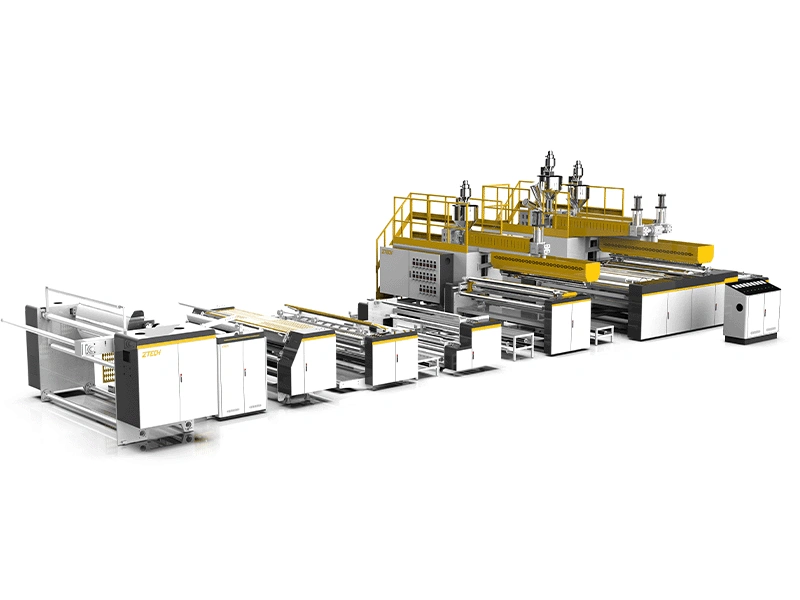
Once the finished structure is defined, translate it into the required bubble film extrusion machine modules.
Confirm the Supported Production Modes
Ask the supplier to state exactly which products the proposed line can produce.
For example:
- 2-layer film only;
- 2- and 3-layer film;
- 2-, 3- and 5-layer film;
- 2-, 3-, 5- and 7-layer film;
- a specific customized structure.
Do not assume that a machine described as “multilayer” can produce every lower or alternative structure.
The quotation should explain the extrusion units, forming arrangement, unwinding positions, lamination modules and changeover required for every production mode.
Confirm Independent Material and Formula Control
For 2- and 3-layer products, identify:
- which extrusion unit produces the bubble layer;
- which unit produces each flat film;
- whether the layers can use different materials;
- whether different formulas can be used;
- whether the color of each position can be controlled separately.
The required degree of independent control depends on the target product.
If every layer uses the same material and formula, a simpler arrangement may be sufficient. If each position performs a different function, more precise material control may be necessary.
Confirm the Lamination and Unwinding Modules
For laminated products, confirm:
- the number of unwinding positions;
- whether lamination is single-sided or double-sided;
- the supported facing materials;
- allowable material roll dimensions;
- tension-control requirements;
- alignment requirements;
- standard and optional modules;
- any required material coating or surface preparation.
The number of layers written in the machine name does not prove that every required material can be handled.
The machine configuration should be checked against the exact facing material that will be used in production.
Check Winding and Downstream Requirements
Different layer structures may affect:
- finished-roll weight;
- roll diameter;
- winding tension;
- edge alignment;
- slitting;
- perforating;
- bag making;
- printing;
- further lamination.
A heavier or more rigid composite may require a different winding arrangement from standard bubble film.
Provide the supplier with the usable width, final roll size and downstream processing requirements before the equipment configuration is finalized.
Verify the Structure With Production Samples
A layer drawing confirms the intended design, but an actual production sample confirms whether the complete process works.
Confirm the Layer Drawing
The supplier should provide a layer drawing that identifies:
- the sequence of all layers;
- the material used in each position;
- the function of each layer;
- which layers are extruded;
- which materials are unwound;
- where lamination takes place;
- the required machine modules.
Use the same drawing during quotation, trial production and final acceptance.
This is especially important for 5-, 7- or customized structures because different parties may otherwise interpret the total layer count differently.
Use the Intended Production Materials
Trials should use materials that are the same as, or sufficiently close to, the planned production materials.
These may include:
- the intended PE resin;
- the proposed formulas;
- PE-coated aluminum foil;
- PE-coated Kraft paper;
- EPE foam;
- HDPE or PE film.
A successful demonstration using an unrelated material does not prove that the machine can produce the buyer’s actual product.
Check the Finished Sample
The sample should be evaluated for:
- the agreed layer sequence;
- complete bubble formation;
- flat-film uniformity;
- facing-material alignment;
- visible wrinkles;
- visible separation between layers;
- width consistency;
- thickness or basis weight;
- finished-roll quality;
- suitability for downstream processing.
When testing a ZTECH line or comparing it with another supplier’s equipment, all machines should be evaluated using the same structure, materials and acceptance conditions.
The objective is to compare demonstrated output rather than general multilayer production claims.
Record the Trial Conditions
Record:
- resin and formula;
- layer structure;
- material used in each position;
- test width;
- target thickness or basis weight;
- running speed;
- sample location;
- measurement method;
- observed results.
A documented trial provides a stronger basis for acceptance and future production setup than a sample without operating records.
Put the Layer Structure Into the RFQ
A supplier cannot recommend an accurate machine configuration when the RFQ states only “five-layer bubble film machine” or “multilayer air bubble film machine.”
The product structure must be described in detail.
Describe the Finished Product
Include:
- required layer sequence;
- material used in each layer;
- function of each layer;
- usable width;
- thickness or basis weight;
- bubble dimensions;
- finished-roll diameter;
- final application;
- facing-material specifications;
- required production modes.
For a customized structure, include a drawing rather than relying on the layer count alone.
Define the Required Machine Scope
Ask the supplier to list separately:
- extrusion units;
- bubble-forming unit;
- in-line lamination unit;
- unwinding positions;
- winding system;
- slitting or perforating modules;
- standard equipment;
- optional equipment;
- excluded items.
This makes it easier to determine whether every required production step is included in the quotation.
Define the Sample and Acceptance Scope
The RFQ should also state:
- materials used during the trial;
- required layer structure;
- sample length;
- inspection items;
- measurement methods;
- agreed finished-product specifications.
Avoid accepting a general demonstration of a different structure when the order is intended for a specific multilayer product.
Compare Suppliers on the Same Basis
All candidate suppliers should receive the same:
- layer drawing;
- material specifications;
- usable width;
- thickness or basis weight;
- bubble requirements;
- lamination material;
- finished-roll requirements;
- trial conditions;
- acceptance criteria.
Without a common product specification, quotations for different machine configurations are not directly comparable.
Conclusion
Bubble film can be produced in more than four possible layer arrangements, but 2-, 3-, 5- and 7-layer structures represent common configurations within ZTECH’s current range. Two layers suit one bubble side and one flat backing, while three layers enclose the bubble section. Five-layer equipment is mainly used for functional in-line lamination, and seven layers support double-bubble or more complex composites. Other structures should be assessed using the same method: define the function of every layer, select the minimum necessary machine configuration and verify it with the intended materials and a documented sample.
Frequently Asked Questions
Can a 4- or 6-layer bubble film structure be produced?
Potentially, yes. Bubble film is not restricted to fixed layer counts. Availability depends on how the manufacturer defines the structure and configures the extrusion and lamination modules. Buyers should provide the complete layer sequence rather than requesting equipment by layer count alone.
Why do different suppliers count layers differently?
Some suppliers count every extruded film, coated surface or laminated material separately, while others describe the product according to the main structural sections. A layer drawing is therefore more reliable than the product name when comparing equipment.
Can the same machine produce both standard and customized structures?
Some multilayer machines support several production modes, but this depends on the number of extrusion units, forming sections, unwinders and lamination modules. Every required structure should be listed and confirmed in the quotation.
When should lamination be completed in line?
In-line lamination may be suitable when the same composite is produced repeatedly and integrating the stages improves workflow. Off-line lamination may provide more flexibility when facing materials and product structures change frequently.
Should future products influence the machine configuration?
Yes, but only when the future structures and materials can be identified. Compare the modules required for current production with those needed for planned products rather than selecting the highest available layer count without a defined application.