
If you are buying a bubble film machine, planning resin consumption, or quoting a customer, the number on a specification sheet is only the starting point. A machine rated at 300 kg/h will not necessarily ship 300 kg of saleable bubble film every hour.
The result depends on finished width, GSM, line speed, uptime, changeovers, scrap and bubble quality. This guide shows a practical way to calculate production capacity and compare machines on the same basis.
Quick Answer: The Bubble Film Machine Output Formula
For a finished bubble film web:
Theoretical output (kg/h) = Width (m) × Stable speed (m/min) × Finished GSM (g/m²) × 60 ÷ 1,000
For planning:
Saleable output = Theoretical output × Scheduled hours × Uptime × Quality yield
Use the effective product width, not the machine frame width, and use a speed the line can maintain continuously—not a short-term peak.
Why GSM Is Better Than Bubble Height
Many capacity calculations use thickness × density. That can work for a flat film, but it is risky for bubble film. A bubble has a raised three-dimensional shape, so its overall height is not the same as the amount of plastic per square meter.
GSM (grams per square meter) measures the actual finished material. To check it, cut a known area from the film, remove any edge trim, weigh it, and convert the result to grams per square meter. A 0.25 m² sample weighing 14 grams equals 56 GSM.
This method includes the base film, bubble layer, laminate and additives. It also gives you a common measurement for comparing two suppliers.
A Worked Capacity Example
Assume a production line runs:
- Effective width: 2.5 m
- Stable speed: 40 m/min
- Finished weight: 60 GSM
The theoretical output is:
2.5 × 40 × 60 × 60 ÷ 1,000 = 360 kg/h
Now assume the factory schedules 20 production hours per day. After warm-up, roll changes and minor stops, uptime is 85%. Quality yield is 97%.
360 × 20 × 0.85 × 0.97 = 5,936 kg/day
The realistic planning figure is therefore about 5.94 tons of saleable film per day, not 7.2 tons based on 360 kg/h × 20 hours.
For rolls, divide saleable weight by the net weight per roll:
5,936 kg ÷ 25 kg per roll = approximately 237 rolls/day
The roll count changes when width, length or core size changes, so kilograms remain the best number for capacity and cost planning.
Four Numbers Buyers Should Not Mix Up
| Capacity figure | What it means | How to use it |
|---|---|---|
| Extruder output | Maximum plasticizing rate | Compare screw and motor sizing |
| Theoretical line output | Width, speed and GSM calculation | Build an initial production plan |
| Gross actual output | Material made during a timed run | Verify machine performance |
| Saleable output | Good rolls after scrap and rejects | Plan sales, labor and delivery |
A supplier may quote extruder output while a buyer expects finished, wound film. Ask which definition is being used before comparing offers.
What Reduces Actual Bubble Film Machine Capacity?
Product conditions
- LDPE, LLDPE, HDPE, PP or recycled content
- Two-, three-, five- or seven-layer construction
- Film GSM and bubble size
- Aluminum foil, kraft paper, EPE foam or HDPE lamination
- Tight thickness tolerance or special surface requirements
Line conditions
- Screw plasticizing and melt pressure stability
- Die flow and gauge control
- Vacuum forming and forming-roller cooling
- Lamination pressure and bond strength
- Haul-off tension and winding speed
- Roll change, screen change and material change time
The fastest setting is not always the most productive setting. If bubbles collapse, layers peel, edges become uneven or rolls telescope, the extra speed creates rework rather than revenue.
How to Select the Right Bubble Wrap Making Machine
Start with your required saleable output:
Required saleable kg/h = Daily target kg ÷ Effective production hours
Then select a machine with enough operating margin for product changes and future growth.
For standard protective packaging, a two- or three-layer line may offer the simplest operation and fastest changeovers. A five- or seven-layer system becomes more useful when you need in-line lamination with materials such as aluminum foil, kraft paper, EPE foam or HDPE film. ZTECH’s product range supports two-, three-, five- and seven-layer configurations, allowing the structure to be matched to the application rather than selected by layer count alone.
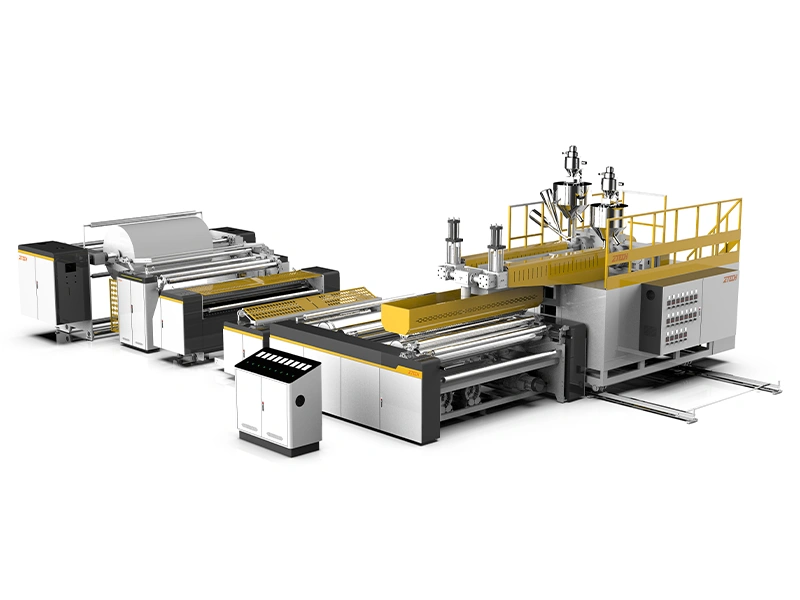
2-layer air bubble film making machine for standard protective packaging
As one reference point, ZTECH’s ZT250-7T listing specifies a 2,500 mm effective width, 800–3,000 m/h line speed and 200–700 kg/h production range. Treat these as model ranges: the guaranteed output must still be tied to your resin, GSM, bubble size and acceptance-test conditions.
How to Verify a Supplier’s Capacity Claim
Put the test conditions in the purchase contract:
- Resin grade and recycled-material percentage
- Effective width, GSM, layer structure and bubble size
- Stable running speed and agreed test duration
- Start-up waste, edge trim and rejected rolls
- Average net weight of finished rolls
- GSM tolerance, bubble integrity, bond strength and winding quality
A four- or eight-hour continuous factory acceptance test gives a more useful result than a five-minute demonstration. Weigh several finished rolls and report both gross kg/h and saleable kg/h.
Common Calculation Mistakes
- Using total machine width instead of usable web width
- Treating bubble height as film thickness
- Multiplying rated output by 24 hours
- Ignoring roll changes and start-up waste
- Comparing different GSM or layer structures
- Counting defective or reworked rolls as saleable output
Conclusion: Plan for Saleable Capacity, Not Peak Output
A bubble film machine’s rated kg/h is useful for initial comparison, but it is not a production promise. The number that matters to your business is saleable output under your actual width, GSM, resin, layer structure and operating schedule.
Use the GSM-based formula for planning, then verify the result with a continuous factory acceptance test. A line that runs slightly slower but delivers stable bubbles, consistent weight and fewer rejected rolls will usually produce more profit than a faster line with frequent defects.
Frequently Asked Questions
How many kilograms per hour can a bubble film machine produce?
It depends on width, GSM, resin, layers and speed. Published machine ranges can span from small lines below 100 kg/h to large multilayer lines above 500 kg/h. Always request output at your exact product specification.
Does thinner film always mean higher output?
Not automatically. Thinner film uses less material per square meter, but forming stability, cooling, tension control and winding can limit practical speed.
What is the difference between a bubble roll machine and a bubble film machine?
“Bubble roll machine” may refer to roll-making or rewinding equipment, while “bubble film machine” usually refers to the extrusion and forming line. Confirm whether extrusion, lamination, perforation and winding are included.
What information should I send for a capacity quotation?
Provide film width, GSM, bubble diameter, layers, resin, daily target, roll weight and operating hours. These details allow the supplier to calculate saleable capacity instead of quoting a generic maximum.