

ABA and Nylon co-extrusion are often compared as if they were two versions of the same machine. They are not. ABA usually describes a layer arrangement: an A layer, a B layer, and another A layer. Nylon co-extrusion describes a material system in which nylon, polyethylene, and usually tie layers are brought together in a multilayer film.
That distinction changes how you choose a bubble film machine. Start with an ABA-type route when the main question is how to arrange and allocate materials within an A/B/A structure. Start with a nylon co-extrusion route when the project requires a multilayer material system in which nylon is included for its film-function role, including gas-barrier and air-retention objectives. Neither route wins simply because of its name, its stated number of layers, or its number of screws. See ZTECH’s Air Bubble Film Machinery range for the related equipment routes.
ABA and Nylon Co-extrusion Are Not the Same Kind of Label
ABA Describes a Layer Arrangement
In film co-extrusion, ABA describes a repeating A/B/A arrangement. The two A layers are the same material family or formulation, while B is the middle layer. That structure tells you how the film is organized; it does not, on its own, tell you what every layer contains, what the finished film will cost, or how it will perform.
This is why “Do I need ABA?” is not yet a complete buying question. The next questions are more useful: What do the A layers need to do? What does the B layer need to do? Which materials are permitted in each position? Is the project designed around a particular film structure, a downstream converting step, or a finished packaging format?
An ABA route is therefore a structure-first discussion. The project team must define the role of each material position before a supplier can assess the appropriate line configuration. Do not assume that every ABA line uses the same resins, the same formula, or the same material strategy.
Nylon Co-extrusion Describes a Material System
Nylon co-extrusion starts from a different question: does the finished film need a nylon/polyamide layer as part of its material system? Polyamide is widely used in flexible multilayer films where gas-barrier, mechanical, thermal, or processing requirements are important. In a PE/nylon structure, the nylon is not simply another version of polyethylene; it introduces a different material function into the film design.
That is why nylon routes normally need a more complete structure discussion. The project must define the nylon grade, the surrounding materials, the intended finished-film construction, and the packaging requirement. A nylon name alone does not predict the result. Layer thickness, resin grade, the rest of the structure, humidity, and processing conditions all affect the finished film.
Tie layers are also part of this material system. They are used in coextrusion to create adhesion between materials such as polyethylene and polyamide. Treating the tie layer as an afterthought can lead to an incomplete film specification: the project needs to define the full material stack, not only the PE and nylon layers.
When an ABA-Type Structure Is the First Route to Evaluate
Define What A and B Need to Do
Start an ABA evaluation when your main design task is to organize a film around A/B/A material positions. Write down the material planned for each position, the finished bubble-film structure, and the packaging product that will use it. This turns “ABA” from a loose equipment request into a film-design question.
For a bubble film project, the finished product still comes first. Is the film going to remain a roll, become a mailer, be combined with another material, or enter a later converting process? The answer determines what information the equipment discussion needs. A line should be evaluated against the intended product structure, not against an assumption that all ABA films serve the same application.
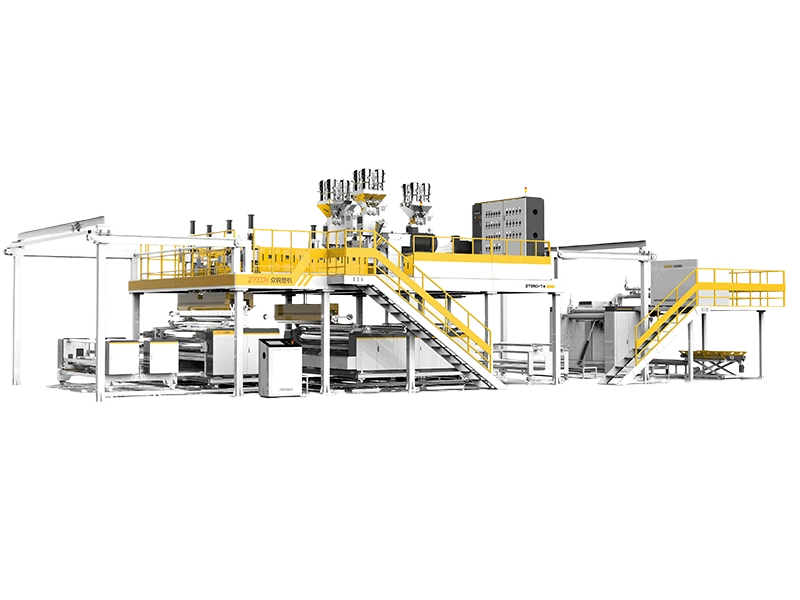
ABA coextrusion air bubble film machine for bubble film projects.
Do Not Treat ABA as One Fixed Formula
Market examples of ABA film use different material strategies. Some projects use the middle layer for a specific material purpose; others are designed around different material allocation requirements. These examples do not create a universal formula for every bubble-film line.
For that reason, do not choose ABA solely because another producer reports a lower material cost, a particular recycled-content strategy, or a certain output result. Those outcomes depend on the formula, film construction, equipment, and operating conditions in that producer’s project. The transferable lesson is narrower: ABA gives the project a defined A/B/A framework in which material positions must be designed deliberately.
When a Nylon Co-extrusion Route Is the First Route to Evaluate
Nylon Brings a Different Material Function
Start a nylon co-extrusion evaluation when the project’s material brief includes gas-barrier or air-retention objectives. Polyamide is used in multilayer flexible films because it can contribute barrier and mechanical functions that are different from a polyethylene-only structure. That makes it a relevant starting point when the packaging product has a defined retention requirement.
The correct conclusion is not that nylon makes every bubble film better. A nylon-containing structure must be evaluated as a complete system. The required barrier level, product weight, shipping cycle, film thickness, material grade, and finished packaging format all belong in the project review. Nylon is a material option with a distinct role, not a shortcut to a guaranteed result.
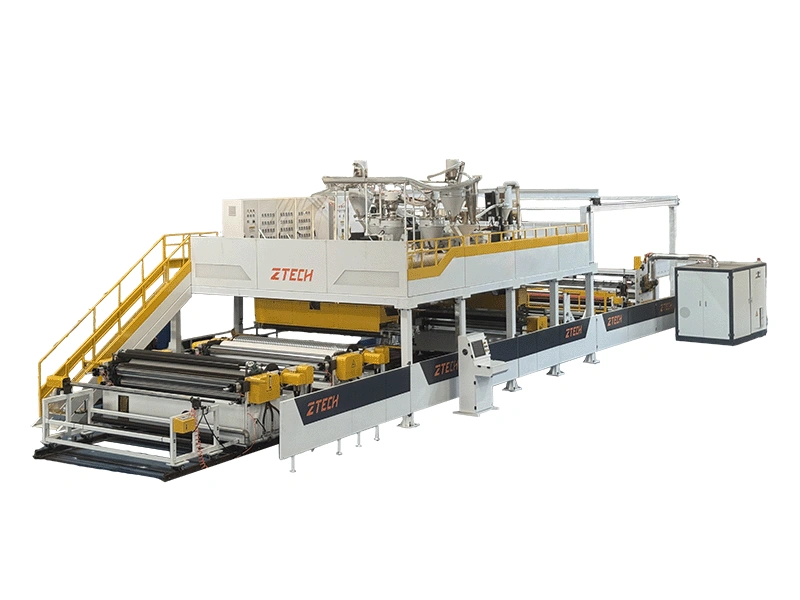
Nylon coextrusion air bubble film machine for multilayer bubble film projects.
Tie Layers Are Part of the Structure, Not a Detail to Skip
When PE and nylon are combined, the tie-layer choice belongs in the film specification. Tie-layer resins are used in coextrusion to bond materials including PE and nylon. This is why nylon structures are normally discussed as a stack rather than as “PE plus nylon.”
For buyers, this has a practical implication: ask to see the complete proposed material structure. Do not approve a nylon route based only on a reference to nylon content. The project should identify the PE layers, the nylon layer or layers, the tie layers, and the finished-film requirement they are intended to meet.
Compare the Whole Structure, Not the Screw Count
Buyers often compare machine descriptions by counting screws or extruders. That is not a reliable route-selection method. In coextrusion, the equipment requirement is tied to the number of different materials and the film structure being processed. A more complex material stack can require a different feeding and extrusion arrangement; that does not create an automatic performance ranking.
Instead, compare these five items:
- Finished packaging job: What product is the bubble film protecting, and what transport or storage requirement matters?
- Full material stack: What are the A, B, PE, nylon, and tie-layer positions in the proposed construction?
- Required film function: Is the project centered on material allocation, gas barrier, air retention, converting, or another defined requirement?
- Processing route: How will the film be formed, wound, and converted after it leaves the bubble-film line?
- Proof plan: What sample, cross-section, or finished-film test will confirm that the chosen structure meets the project requirement?
This framework is more useful than asking which route has more layers or more screws. It connects the machine decision to the actual bubble film and packaging product.
Applying the Market Comparison to ZTECH Routes
ZTECH’s ABA route is a concrete example of a polyolefin-based co-extrusion route. Its stated bubble and bubble-base structure is PE + PP/HDPE + PE, and ZTECH positions it for bubble film–aluminum film express bags. Its listed ABA machine uses four screws and two dispensers with independent thickness and flow-rate control for the stated structure.
ZTECH’s Nylon route is a concrete example of a PE/TIE/NYLON material system. Its stated bubble and bottom-layer structure is PE + TIE + NYLON + TIE + PE, and ZTECH positions it for high-end products and long-distance transportation requiring long bubble air retention. Its listed Nylon machine uses six screws with independent thickness, material-ratio, and flow-rate control for the stated structure.
Use these two ZTECH routes as starting points, not as universal definitions of ABA or nylon co-extrusion. If your project is a bubble film–aluminum film express bag, begin the discussion with the ABA route. If it has a defined air-retention objective for a high-end, long-distance transport package, begin with the Nylon route. Then review the full structure and project requirements before finalizing a configuration.
| Comparison point | ABA coextrusion route | Nylon coextrusion route |
|---|---|---|
| Start here when your project is for | Bubble film–aluminum film express bags | High-end products and long-distance transportation requiring long bubble air retention |
| Stated material structure | PE + PP/HDPE + PE | PE + TIE + NYLON + TIE + PE |
| Listed machine configuration | Four screws and two dispensers; independent thickness and flow-rate control | Six screws; independent thickness, material-ratio, and flow-rate control |
| Next project check | Finished express-bag structure, materials, bag format, and downstream step | Finished-film structure, materials, packaging format, and downstream step |
Conclusion: Choose the Route by the Film Job
Choose ABA when the project is fundamentally about an A/B/A material arrangement and the role of each material position. Choose a nylon co-extrusion route when the project requires a PA-containing multilayer system to address a defined barrier or air-retention objective. Then validate the decision with the complete material stack, finished packaging format, process route, and relevant finished-film evidence.
For a ZTECH configuration discussion, contact our team with the target packaging product, a finished-film cross-section or sample, material requirements, required width, delivery form, downstream converting process, and the properties the project needs to validate.
Frequently Asked Questions
Is ABA a material, or is it a structure?
ABA is normally a layer arrangement: A/B/A. The actual materials used in the A and B positions depend on the product design and supplier configuration. Do not treat ABA as one fixed resin formula.
Does nylon automatically mean the best air retention?
No. Nylon is a material option used in multilayer films for functions including gas barrier, but air retention in a finished bubble film depends on the full structure, material grade, layer design, processing conditions, and the final packaging application.
Can I choose by screw count?
No. The number of screws or extruders reflects the materials and structure the line is designed to process. Compare the full material stack and the finished-film requirement instead.