

When bubble wrap passes inspection but fails during shipping, thickness control is often the hidden problem. A roll may look full while its film skin is too thin, or the film may meet its average target but vary sharply from edge to edge.
This guide explains how to define, measure and control bubble wrap thickness on an air bubble film machine. It focuses on practical production decisions: where variation starts, how to verify it, and which machine or material adjustments actually improve consistency.
Quick answer: Bubble wrap thickness is controlled by resin flow, T-die uniformity, vacuum forming, cooling, lamination and winding tension. Measure film skin gauge separately from bubble height, sample several web positions, and adjust one process variable at a time.
What Does Bubble Wrap Thickness Really Mean?
“Thickness” can describe four different values:
| Measurement | Meaning | Why it matters |
|---|---|---|
| Film skin gauge | Thickness of the PE or PP film layer | Determines material strength and cost |
| Bubble height | Height of the air pocket | Affects cushioning and compression resistance |
| Total caliper | Overall thickness including the bubble | Used for packing volume and handling |
| Basis weight | Mass per unit area, usually g/m² | Useful for production and material-cost control |
One mil equals 25.4 μm. However, a specification such as “30 μm bubble film” is incomplete unless it states whether the value refers to one film layer, the total structure or a calculated average.
For embossed bubble film, a conventional micrometer can compress the bubble and produce a misleading result. Every purchase specification should define the measurement point, instrument pressure, sampling plan and permitted variation.
Why Is Bubble Film Thickness Uneven?
| Visible symptom | Likely cause | What to check first |
|---|---|---|
| One side is thicker than the other | T-die gap or melt-flow imbalance | Measure thickness across the web |
| Repeating thick-and-thin bands | Unstable screw speed, feed rate or melt pressure | Review pressure and output trends |
| Bubble height changes continuously | Unstable vacuum or blocked forming-roller holes | Check vacuum pressure and roller surface |
| Weak or leaking lamination | Incorrect roller pressure, temperature or alignment | Perform a peel and air-retention check |
| Wrinkles and roll-edge variation | Uneven traction or winding tension | Compare traction speed with winding tension |
| Quality declines after several hours | Die buildup, thermal drift or cooling loss | Compare start-up and steady-state data |
Raw materials also matter. Changes in melt flow rate, moisture, contamination, color masterbatch or recycled-content ratio can change melt viscosity and layer distribution. A stable machine cannot compensate for an uncontrolled material recipe.
How to Measure Bubble Wrap Thickness Correctly
Use a repeatable six-step procedure:
- Define the target. Record film skin gauge, bubble height, total caliper or basis weight.
- Create a sampling map. Take measurements at five to nine transverse positions and at the roll start, middle and end.
- Use low measuring pressure. A total-caliper gauge must not crush the air pocket.
- Measure the flat film layer separately. For embossed material, isolate or flatten the film skin before applying a controlled method. ISO 4593 is intended for mechanical scanning of plastic film but is not suitable for embossed film.
- Cross-check by mass. Use: Average thickness ≈ Mass ÷ (Density × Area).
- Track variation, not only the average. Record average, maximum-to-minimum range, standard deviation and coefficient of variation.
ASTM D6988 can support laboratory measurement practice, but it should not replace a buyer and supplier’s agreed commercial QC specification. The most useful production record combines thickness data with resin batch, screw speed, melt pressure, vacuum level, cooling temperature and winding tension.
How to Control Thickness on an Air Bubble Film Machine
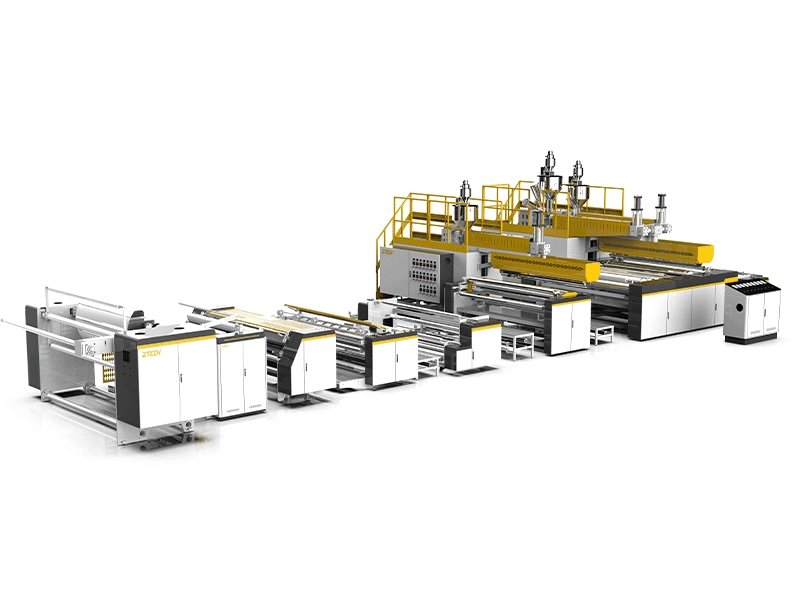
ZTECH 5-Layer Air Bubble Film Lamination Extruder
1. Stabilize extrusion
Keep temperature zones, feed rate, screw speed and melt pressure stable. Clean the T-die regularly and remove material buildup that can restrict one section of the flow channel.
For multilayer production, independent control of each layer is valuable. ZTECH’s two-layer equipment is designed to regulate the bubble layer and base layer separately, helping operators adjust material distribution without changing the entire structure.
2. Control vacuum forming and cooling
The forming roller determines bubble shape and repeatability. Check vacuum pressure, hole blockage, roller surface wear and roller temperature. If bubbles become shallow or irregular, inspect the vacuum and forming roller before simply increasing film thickness.
Cooling must be uniform across the working width. Temperature differences between the forming roller and cooling rollers can freeze one area earlier than another, creating transverse gauge variation.
3. Match lamination and winding
Lamination pressure and temperature influence seal strength and local film compression. Misalignment can create thin lines, leaks or wrinkles.
The traction system must match extrusion output. Winding tension should remain stable as roll diameter increases. Slipping rollers, incorrect tension feedback or excessive pressure can make a good film appear defective after winding.
4. Adjust one variable at a time
A practical adjustment order is:
- Material and filter condition
- Extrusion temperature and melt pressure
- T-die flow balance
- Vacuum and forming-roller condition
- Cooling uniformity
- Lamination pressure
- Traction and winding tension
Wait for the line to stabilize after each change. Changing several settings at once removes the evidence needed to identify the real cause.
Choosing the Right Bubble Wrap Material and Machine Structure
| Structure | Best suited for | Main advantage |
|---|---|---|
| 2-layer PE | General cushioning and surface protection | Simple, economical production |
| 3-layer PE | Higher puncture resistance and improved surface quality | Independent layer control |
| 5/7-layer laminated film | Kraft paper, aluminum foil, EPE or HDPE composites | More functions in one production line |
| ABA coextrusion | Rigid, durable film and mailer applications | Controlled PE/PP or PE/HDPE structure |
| Nylon coextrusion | High-value products and long-distance shipping | Improved toughness and air retention |
Published ZTECH specifications illustrate why output must always be linked to a specific model. The ZT150-2T lists a maximum width of 1,540 mm and a capacity range of 80–200 kg/h. The ZT200-5COX lists a maximum width of 2,040 mm and a capacity range of 150–700 kg/h. These are model ranges; final performance depends on material, layer structure, bubble size and target basis weight.
Importantly, g/m² is basis weight, not micrometer thickness. It should not be converted into film gauge without confirming resin density and the number of layers.
Application-Based Recommendations
| Application | 重点控制指标 | Recommended direction |
|---|---|---|
| Electronics | Anti-static protection, consistent layer thickness | Multilayer structure with functional additives |
| Furniture and glass | Puncture resistance, stable bubble height | Medium or heavy-duty structure |
| E-commerce mailers | Lamination strength, winding stability | ABA or multilayer structure |
| Long-distance shipping | Air retention, compression resistance | Nylon coextrusion |
Expert Tips and Common Mistakes
Expert tips
- Use a thickness map instead of one average reading.
- Keep a calibration record for every measuring instrument.
- Link QC results to resin batches and machine settings.
- Set acceptance limits before production begins.
- Use ZTECH’s machine test data to confirm width, output and material compatibility.
Common mistakes
- Pressing a standard micrometer directly onto the bubble.
- Treating bubble height as film gauge.
- Measuring only the roll start.
- Changing temperature, vacuum and speed simultaneously.
- Assuming thicker film automatically means stronger packaging.
Final Takeaway
Consistent bubble wrap thickness comes from controlling the complete line, not from adjusting one setting. Define the measurement, map the variation, stabilize extrusion and vacuum forming, then confirm the result with repeatable QC data.
For a ZTECH recommendation, provide your target width, bubble size, layer structure and output requirement. The engineering team can then propose the suitable air bubble film machine, material configuration and testing plan.
Frequently Asked Questions
What is the best bubble wrap thickness?
There is no universal best value. The correct specification depends on product weight, drop risk, shipping duration, bubble size and material structure.
Why is one side of my bubble film thicker?
Start with the T-die flow balance, material distribution and cooling uniformity. Measure several positions before adjusting the die.
Can a micrometer measure bubble wrap?
Only with a low-force fixture and a clearly defined measurement point. Direct compression of the bubble will distort the reading.
Is industrial strength bubble wrap always thicker?
Not necessarily. Layer structure, bubble size, sealing and air-retention performance are equally important.
Which ZTECH machine is suitable for high-strength bubble film?
Choose a 3-layer, 5/7-layer, ABA or Nylon coextrusion machine according to the required film structure and application.
What information is needed for a machine quotation?
Provide target width, bubble size, layer structure, raw material, basis weight or film gauge, required output and application. This allows the machine configuration to be matched to the actual product.